
Note 60
It is the sixtieth time we are publishing a set of stories that touch on the lives, and the psyches of characters from the subcontinent and the diaspora. We publish only a very small number of our submissions per quarter, around 5 per cent each issue. And that thought makes me reflect on the number of stories, we choose not to publish, stories that are often perceptive examinations of complex emotional, psychological and societal situations, but which do not make it into the final list for a variety of reasons: structure, language, tonality … I could go on. Regardless, what is clear is that the issues that writers examine in the context of the subcontinent are often difficult and complex, and the ways in which the stories are written and structured – funny, serious, reflective, first person, third person, complex, linear, surreal and so on – lead us into thinking deeply about that elusive and oddly uniting thing we call culture.
In this issue, we feature nine stories, with seemingly little connection barring that they come from the same ‘culture’. I should emphasise that this lack of connection is not something I worry about, since we generally do not seek thematic coherence in an issue. Rather, we choose a story based on whether we see something in it. This can lead to an apparent randomness in the eclectic set we bring out each quarter. However, to me, when putting the works together for each edition, I find they have a certain coherence, a subliminal connection. This time, when a couple of stories were held back by the authors for different reasons – prizes, revisions, the slender filament of commonality that ran through the set seemed to have gotten even more fragile. But writing this Editor’s Note has brought back to my mind, the nuanced rationality that links the stories. In each of the stories, the protagonist appears to be seeking something, often a search that runs subterranean, underneath the layer of action, a searching, however, that impresses itself on the character and thus, on the narrative.
Anjum Hasan’s ‘‘Like a Scene from All Those Movies’’ is set in a Bangalore of over twenty years ago, when the things that drove people were informed by a different kind of city. The narrator is a recent immigrant to the city, and we see places and characters through his eyes. With her usual brilliance, she opens windows on many of the subworlds that constituted life in the city. The story is accompanied by a comment by Anjum on revisiting and republishing the story decades after it was written.
Playwright, Tripurari Sharma’s ‘The File of Life’ deals with the ludicrous yet critical issues that emerge when a single mother wishes to register a child’s birth, particularly in a village environment. The mother’s determination to guard her son is made evident, and the relationship between mother and son is revealed. There is drama in the story, theatre in the idea of the chorus in the guise of ‘the people’ who reinforce decisions and actions. The story, which was submitted to us by the author, is published posthumously.
Also set away from the urban world is Alka Saraogi’s ‘Shyama Dhobi, Where Are You?’, a chapter excerpted from her novel Register Me as Kulbhushan, translated from Hindi by John Vater. In the midst of the Bangladesh War of Independence, we see the impact of Partition on the young protagonist, the son of a Dhobi, whose ruminations emphasise the disruptions in the lives of people caught in the crossfire of politics and war around territory.
Three stories deal with the end of life. Yashasvi Vachhani’s ‘Is Sundari Raisinghani Happy?’ introduces us to a most self-aware and curious woman who is suspended after her death, pondering on her life and the many transitions she has gone through, the many identities she has held. In ‘Mrs Kamala’s Letters’ by Sourabh Arora, a story of release, a woman deals with grief by sharing her life with her dead husband by writing regularly to him. Through quotidian detail, we are given a glimpse into her angst, her loneliness and their marriage. In ‘Fading Out’, Bodhisatwa Ray takes us through the experience of being quarantined in a hotel in Mumbai during Covid. The glass window overlooking the street offers a view of the empty world outside as his life, incarcerated in his hotel room, draws him into an ever-present space in his mind that dwells on a deep and unrealised love.
Srajana Kaikini’s ‘The Dwellers’ crosses continents, and cities with the thoughts and actions of its protagonist, Justin, who has ‘blue eyes and the will of a monk’. A house painter who wanders the world seeking histories, he touches and is touched by the lives of the people he meets and the homes he paints, with an intensity that draws us in.
In Bhim Singh Bhavesh’s, ‘God Bless the Pandit’, translated from Hindi by Ankit Raj Ojha the complexities of joint family life are revealed through the politics around the serving of food, specifically the pua that the main character, the widower father-in-law describes – ‘thick batter of maida, bananas, sugar and sooji goes into making kela pua. Add some khoya to the maida, then simmer the pua in thick milk, and you have doodh pua.’
Mridula Garg was arrested in 1980 for explicit descriptions of sex in her Hindi novel Chittacobra that explores female love and desire in an empty marriage. In this short story, ‘Entranced In Venice’, she explores similar themes of emptiness, passion, and yearning that come to a fore on a trip to Venice.
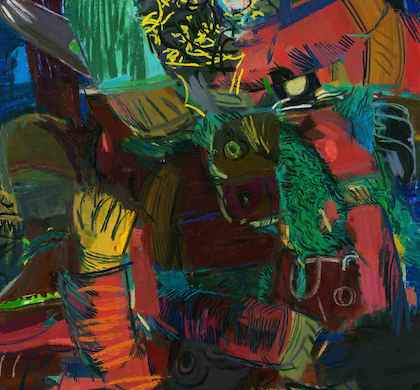
The image on the cover is by Sangram Majumdar, titled ‘A State of Unrest’, part of the series Bad Actors, oil on canvas, 198 x 137 cm, 2026.