
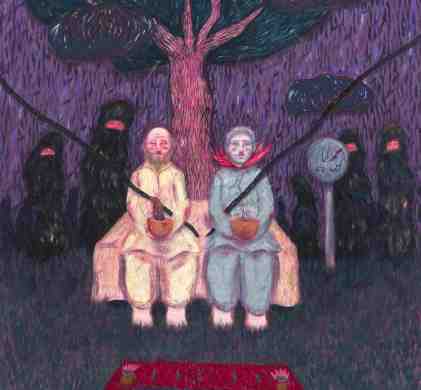
Outside Women – Chapter Six
The bomb separated us.
India had an atomic bomb, and everyone in Pakistan celebrated when we learned that we had one too. The day after the nuclear tests, shadows crisscrossed the arched courtyard of our Peshawar college. They fell in geometric patterns across the faces and fists of men who gathered to cheer the news. My friends and I watched from a third-floor corridor above them, as if banished to watch from the wings.
From our vantage point, the men were a pack of black heads and white prayer caps. The white and black circles jumped and dipped. Courtyard acoustics made their voices into cacophony. One burst into a kind of dance, and soon, others followed suit with arms outstretched.
Mohsin faced the crowd and led them in slogans cobbled together from old truisms. His expression was triumphant and satisfied – he was clearly so ready to gather up the energy of this moment toward his own purpose. I scanned the faces around him and dared to hope I’d be wrong. But there, steps from Mohsin. Ali’s lips were set in a line. His hands clasped before him were not empty. At a shout from Mohsin, Ali hoisted a large poster high up above his head. A drawing of Dr A Q Khan the physicist, an unlikely hero for their cause. The cheap cardboard seemed to vibrate as it loomed. Mohsin riled the crowd in a repeated chant. Bhaarat? Murdabad. Pakistan? Zindabad.
As if the fiery destruction of one could spell anything but the end of us all. Our fragile bodies could not be safeguarded by a border. Each chanted call cracked deeper at the fissure separating me from my brother. We’d never find our way back to each other.
‘All You Need Is Pyaar’ came to me in a pamphlet during those churned-up weeks after the nuclear tests. The yellow paper photocopy bore a clumsily sketched origami crane on its cover along with Pakistan and India flags crossed back to back. At the meeting I attended, a handful of would-be peace activists showed up in search of a home amid the bloodthirsty celebrations.
Marjan – a gray-eyed girl with a golden fringe peeking out from her chaadar – spoke Urdu with Afghan cadence. She stood on a chair to project her soft, assured voice: ‘We need a show of peace. Let’s show the world we’re more than a nation of warmongers.’
I glanced around at the solemn nods and murmurs. Twenty or twenty-five students had gathered for what was likely their most successful meeting ever. Hundreds assembled in the courtyard for Mohsin’s impromptu demonstration. What chance did the meek have? I was sceptical, but I didn’t know where else to go. The courtyard chants had stirred a deep anger in me. I didn’t understand it then, but I was already a student of history. I didn’t have to look far to know this gathering nationalism was false and dangerous. But more than anything, I seethed at the idea of men in power directing my allegiance. They would not manipulate me into offering up my life for their greed.
Without anywhere else to channel this indignation, I copied down the details of the organising committee meeting. A few days later, I found Marjan at the back of Zaheer Books, moving piles of dusty hardcovers aside to make room for a few folding chairs.
‘The owner’s a friend of the family,’ she explained with a smile and thrust a stack of economics textbooks at me. He’d allowed the group to meet at the back of his conveniently located bookstore.
Saeed, a lanky student in oversized glasses and a patchy moustache arrived soon and helped snap open five chairs. A quiet, wide-eyed woman I remembered from my sociology lecture hall also showed up. The bookstore assistant brought us an enamel teapot of hot doodh patti and four chipped cups. Over chai and a box of zeera biscuits, we commiserated about our patriotic family members and jingoism on the news. Marjan eased the conversation from complaint to action, and we batted around ideas for a peaceful counterpoint: An opinion column for The News, where Saeed had a journalist uncle.
Pamphlet distribution at the Sunday bazaar.
None of us were particularly excited by the proposals. But we emerged blinking into sunlight with another meeting date planned and tasks assigned for the meantime. On the bus ride home, I noticed my chest lighter and my hands steadier. I leaped off at my stop, took quick steps down the street, and ran up the stairs to our home – because I could, because my feet wanted to.
A car was on fire. My friend Samina and I came upon the blaze in front of the old canteen at the edge of campus. The silence unnerved me. No one to cheer on the flames or put them out. The air shimmered like a halo, foul stench trapped in my hair. Though the torched car was only one symptom of rising unrest at our college, I would remember it as the beginning. A flare signalling danger to come.
‘Hartal,’ Samina said breathlessly some days later, arms crossed over her chest. A few of us were waiting for our professor in a mostly empty lecture hall. Samina slipped out to investigate the delay and spotted signs of riots in the distance. We hastily packed up our belongings. Hartal had been declared at our college in the past and could mean stampedes, crowded buses, shuttered shops in the surrounding neighbourhood. We hurried toward the college gates like beleaguered itinerants, weighed down with bags, papers, library books. Who knew when we would be allowed back inside.
Clouds had begun to gather that morning, and at midday, thunder murmured ominously. A susurration of chants rose and fell. The sound took shape and grew closer, but we couldn’t identify the words. Samina wrapped a corner of her chaadar across her nose and mouth as if to shield herself.
Beyond the gates, we dispersed and hailed auto-rickshaws, not caring to trust our safety to buses or dabba vans if we could help it. Samina raced ahead, pushed others aside, and grabbed hold of an autorickshaw with both hands. She yelled at me to catch up, and I swung in beside her as the auto zigzagged past me. We were off in a roar of fumes, scattering pigeons in our wake.
Samina leaned back and hugged her book bag. Her family was strict, and Samina’s permission to attend classes already hung by a frail thread. If she were stuck without transport during a riot, that could spell the end of her college career. I reached out and squeezed her arm. She glanced up, and our eyes met in a brief moment of sympathy – too brief. We were jolted forward as the autorickshaw screeched to a halt. I stuck my head out and was almost thrown clear as the driver swerved in a wild reverse U-turn. He swore at us, our forefathers, and his own fate as he struggled to keep the vehicle upright through his manoeuvres.
Samina’s shrieks in my ear, I spotted the overturned car. The man curled into a ball on the ground clutched his head as another kicked him until his chappal flew off into the dust. Other men rammed cricket bats and hurled rocks at the car. One of them dragged the tape deck through a window. Wires trailed through broken glass.
The autorickshaw sped a few blocks in the opposite direction, then another. The driver continued muttering oaths. We were too stunned to ask where he was taking us. Eventually, he raced down a wide avenue toward the safe Cantonment district. Neither of us tried to stop him, though it was far from our own neighbourhood. Letting us out at a busy market, he entreated us to call our families before he slumped forward and retrieved his snuffbox with shaking hands.
It was hours until Samina’s family could cross town and rescue us from the video store where we camped out and waited. She wept all the way home in the back seat of her uncle’s car. She knew she’d never be allowed out on her own again.
In the weeks that followed, I had to stay home too. It turned out the Islamic groups on campus were protesting pro-India comments a professor had made. But that was just the spark that lit a fire. Hostilities between India and Pakistan had worsened since the nuclear tests. The many factions across our university were eager to manipulate emotions riding high. Mohsin had recently formed one such student group, attached to the political party his uncle commanded as a member of parliament. Islam was their fashionable excuse.
I suppose it’s easy to understand why Ali threw himself into the riots. Son of Indian refugees, he’d always been desperate to prove he belonged in Peshawar. What better way to shout his allegiance than by denouncing a traitor.
I was cleaning when Mohsin brought him home. Cooped up while college was closed, I’d pulled out stacks of old notes and was attempting to organise them when I heard laboured steps on the stairwell.
‘Y’Allah!’
I ran out to find my mother frozen, an end of her dupatta clutched at her mouth. I skidded to a stop at the railings as Mohsin heaved Ali up the last few stairs. Ali leaned against him and seemed to favour one leg over the other. One side of his face was covered with blood.
‘It’s not so bad,’ Mohsin panted as he gave up his burden to my mother’s trembling hands and a chair I had pulled in from the dining room. ‘It looks worse than it is. Things got a little … messy at the rally today.’
‘What, what is this?’ my mother whispered as she ran her fingers over her eldest’s face.
‘It’s just—’ Ali tried to speak but grimaced midsentence and ran his tongue over his split lip.
‘Hajra! What are you staring at?’ My mother gave me a push without turning to look at me. ‘Go, boil a kettle of water, get Dettol, a towel, go, go!’
A flare of anger shot up in my chest. She could look after her foolhardy son herself. If he wanted to risk his life on his war cries, why should we care?
But I’d been taught well to swallow my bitterness, so I did as I was told. I wrung bloody towels into a bucket of hot water while my mother bound Ali’s foot and raised it onto a stool. Her lips were pressed firm, her silence deadly. Mohsin was long gone.
‘Ammi, leave it, really, this is too much,’ Ali tried to protest as she fussed with the binding. A mistake. She dropped the bandages and rose to her full five-feet-zero. He cowered in his dining chair.
‘It’s too much. Too much,’ she repeated. ‘Are we too much for you? Are we giving you too much trouble? Inconveniencing his highness, who has many important tasks out there in the world? Who—’
I tried my best to be unobtrusive as I gathered up the bloody rags and bucket and tiptoed to the bathroom. She was just getting started.
Ali didn’t spend much time at home anymore. On those nights when he returned from the demonstrations, his clothes were filthy. My mother begged him to stay, especially after that bloody episode. But he’d just bathe, change, and leave again. Occasionally, he’d fall asleep on the sofa for a couple of hours. I found him like this one night when I woke to get a glass of water. I was seized by reflexive terror at the stranger prone in our living room. In the next instant, I saw that it was my brother. But my fear did not abate with the knowledge. That was how I learned I was afraid of him.
I tried to focus on my work with Pyaar instead. We met a few more times while college remained shut; the meetings provided an outlet for our frustrations. Materials began to spill over my desk and accumulate around the house. A pile of photocopied pamphlets in a shoebox by the front door was ready for Sunday. Newspapers were spread out on the dining table, where I analysed opinion columns and underlined inspiring phrases.
One evening, I found Ali leaning against the kitchen counter. A Pyaar pamphlet was propped open in one hand; his other held a stale chapati rolled around a shami kabab. We exchanged a glance heavy with implication before I turned to the sink to wash my teacup and bowl and place them on the rack. I was drying my hands on a towel when he spoke.
‘You’re better off spending your free time on ibaadah and Quran study. Don’t waste it on this silly nonsense, Jerru.’ His rubber slippers squeaked as he left.
I spun around – my mouth open to respond – but he was already gone. I was confused by the kindness in his voice and the childhood pet name. Layered through with condescension, the medicine was sweetened but still bitter. I gritted my teeth and flung the towel hard against his dirty plate. The greasy frying pan he’d left to crust on the counter.
‘Pamphlets and articles are not enough.’ College had been closed for weeks. Our core Pyaar group met and papered the old city walls with posters and handed out fliers at bazaars. We even managed to get a letter to the editor published in The News, in which we pled our case for peace with India. So when I made my pronouncement that day, the others looked at me with surprise. Things were going well, they countered.
‘Who’s going to take us seriously with all this pen and paper nonsense?’ I stared each of them down in turn.
‘Serious people, those who think. They will take us seriously.’ Marjan returned my stare coolly. ‘The others are not our concern.’
‘But ‘the others’ are the ones who’ve shut down our college! They’re the ones holding us hostage.’
We argued back and forth as the other members watched our tennis match in silence. ‘Look who we’re dealing with.’ Marjan threw up her hands in frustration. ‘You want to reason with these people? Like the Taliban, who would chop off my head in a football stadium? They’re all ready to die for their madness. Is that what you want?’
I bowed my head, momentarily silenced, but my indignation fumed. I knew Marjan wasn’t the right target for my anger. Those men were – the stadium murderers, the nuclear bullies. The men who had shut down my campus, scattered my freedoms, and left me trapped indoors. My only brother, who might one day become one of those martyrs ready to die for someone else’s profit.
I glanced up, mind racing. Maybe death was what I wanted after all. ‘I have an idea.’
We chose the day of their rally in the old city. Mohsin’s uncle and his party had teamed up with the student association to bring attention to the young people’s cause. Cloth banners called the faithful to gather after Friday prayers at Chowk Yadgar, the domed monument in the heart of the old city, where stray cats and heroin addicts spent their nights. We moved through the ancient alleys covered in shuttlecock burqas. Ten of us were split up in twos and threes. Shops were shuttered for afternoon prayers, but women and children loitered in the streets, where they picked through rubbish and gathered crumbs. We were not out of place among them.
When the men streamed out of mosques and spilled through the arteries toward the central chowk, we slipped into the current. We were not invisible in our burqas but close enough. As planned, we tried to follow older men so we’d be mistaken for their women and left alone. It seemed to work.
In the grounds around the Chowk, some 100 or 150 men assembled and called out slogans as party leaders climbed inside the dome and took up loudspeakers. Dispersed among the crowd, we waited for our moment. Under the burqa’s anonymity, we could check our wristwatches as often as we liked.
It was time. Heat flushed through my body up to my temples. I shut my eyes to the dust of old places, stink of refuse, buzzing flies, crackle and hiss of men listening to their leaders. I unpinned the white sheet splattered in red paint from around my torso and let it drop under the burqa. As practiced, I pulled one corner over my shoulders and head. For an instant, I panicked as cotton layers stifled me. But I found the holes I’d cut for my nose and mouth and inhaled deeply.
One hand free, one pushed against the bodies around me, I flung the burqa from me onto the ground, buckled my knees, and let my body collapse. Abandoned burqa beneath me, I lay on the ground clad in a white shroud and trembled as I attempted deathly stillness. Later, our friend from The News told us the crowd quieted when we all fell. In that instant, confronted by our scattered and shrouded bodies, the men were sombre. The party leader’s voice up front faded into confusion. A photographer captured Mohsin’s stricken face caught between fury and bewilderment at our theft of his limelight. On the ground, I knew only chaos. I lay still for moments of terror before I was pushed from the space I’d claimed.
We were lucky. Most of our bodies were only bruised by the stampede. One protester twisted her ankle when she scrambled to her feet. Marjan chipped a tooth in the tussle with an enraged man who pulled her up by her hair and tore off her shroud. He shook her hard and slapped her across the face before she got away. I was kicked once. The shape of a chappal bloomed across my hip later. But I suffered no lasting damage.
‘Police.’ An urgent voice to my left. Sirens. I pulled the shroud over my head, and inside out, it became an ordinary chaadar. I became another small woman scurrying through empty streets, escaping the sudden violence of men.
Chhotu Chacha lifted his copy of The News above his head as he walked in. ‘Did you know? We’re famous. Look, black and white.’ He slapped the paper for added emphasis. ‘Famous, our own bitya.’
My mother sighed over her prayer beads. She didn’t bother to emerge from her sulk for the visitor. The previous day’s paper had printed a small article with a black-and-white photo to cover Pyaar’s die-in at Chowk Yadgar. Since then, we’d alternated between shouting matches and icy silence at home. How-could-you and think-of-your-parents and this-is-the-real-world and danger and forbidding and tears.
I was grateful for Chhotu Chacha’s interruption of the cycle.
Since it was Sunday and no one seemed to have anything better to do, the elderly sisters from across the street dropped by. Our flat buzzed with their gleeful horror at my daring as everyone sat around in clumps of conversation.
My mother sniffed loudly and got to her feet – she wanted no part of this gossip. ‘I’m going to pray,’ she said with a regal flourish of her dupatta and left the room.
‘But weren’t you afraid?’ whispered Chhotu Chacha’s young wife, Nusrat. Wide-eyed, kohl-rimmed, frost-lipped. Only a year older than me. Her little son slept in her lap, toy car sticky in his grip.
‘Afraid of what?’ I tried for nonchalance, and perhaps I managed to fool her.
‘Wah, Hajra.’ She grimaced as she shifted the slumbering child from one knee to the other and shook out her numb foot. ‘No fear? Of those men looking at you and Allah knows what they want and no one to protect you. Astaghfirullah, all alone out there.’ She indicated the window with her chin and let a stage shiver run through her. Then, she paused. ‘What is that sound?’ Strains of a guitar drifted in from the next room. ‘It almost sounds like a … helicopter,’ she mused.
Any words I might have chosen in response were drowned out. ‘WE DON’T NEED NO EDUCATION.’ Chhotu Chacha burst in, shouting along to the blaring boom box on his shoulder: ‘LEAVE US KIDS ALONE.’ He got through another few bars before my father managed to grab the boom box from him and turn it off.
‘What are you doing?’ Nusrat bounced the wailing child woken by his father’s music. The neighbour sisters shook their heads and whispered among themselves.
‘Just thought Hajra would appreciate some Floyd. Our fighter bitya.’ He grinned at me from the doorway, irrepressible. I couldn’t help but grin back. Because behind his usual silliness was also pride in his own. No one else in my family had expressed any so far. Instead, they looked at me with disbelief, as if they couldn’t recognise this stranger among them.
Aside from my mother’s warnings and my father’s disappointment, Ali was conspicuous by his absence. He came home late at night and slept on the sofa, then rose early for Fajr prayer and left before any of us woke. He said nothing about the protest.
As Chhotu Chacha flashed me an exaggerated thumbs-up, gratitude welled in me. Maybe there was room in my family for me to become the kind of woman I longed to be. This fighter bitya.
My mother shuffled back into the room, her pale face stained by tears. Her eyes were rimmed with dark circles, and blotches of red streaked her skin. Muttering prayers under her breath, she made a beeline for me on the divan. As I looked up and met her gaze, she took my cheeks in her hands. My lids fluttered shut as she breathed her prayers cool around the dips and crevices of my face. She kissed my forehead once with trembling lips before she withdrew. Her blessing lingered on my body.
Excerpted with permission from Outside Women, University Press of Kentucky, 2025 as per the copyright statement below:
Choudhry, Roohi. Outside Women: A Novel. pp. 41-50. © 2025 Roohi Choudhry. Used by permission of The University Press of Kentucky.