
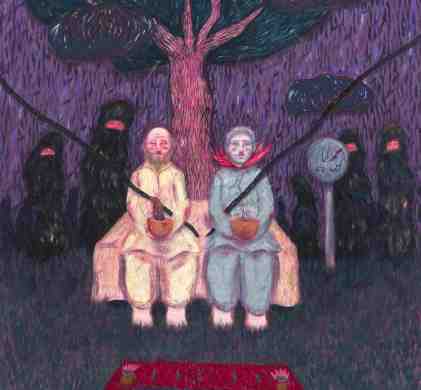
The Womb
The result of the most important examination of your life was delivered to you with a wand in your vagina. A doctor at the HappyBirth IVF Centre, her sympathetic smile perfectly measured, told you the baby was gone. Absorbed. Leaving behind only an empty sac.
In that moment, your world that had just begun to expand with new hope, imploded. Lying on the hospital bed, you saw your baby crawl out of your inhospitable womb into the clean, cold room, slide silently past the nurses toward the exit, outside which sat several aspiring mothers with looks of hopeful dread or dreadful hope.
At the door, your baby turned once to say goodbye before vanishing.
You felt hollow, emptied,
like a temple robbed of its God.
Abandoned by your own baby,
betrayed by your own body.
That third time, you finally realised the unborn baby’s existence outweighed all your physical, emotional, and spiritual pain. You knew it was time to choose yourself, even if it meant letting go of those who once mattered more to you than you did.
That was thirty years ago. Today, you’re better. Women’s worlds are better. Today, both the examination and the IVF Centres are obsolete. Now, we have WOMB (Woven Ovum Manipulation & Birthing) facilities. A marvel of modern medicine, a blessing for thousands of hopeful parents and a quiet curse for several children born within its walls.
You’ve been a Senior Manager at the facility since its inception in Bangalore, two decades ago. It’s the largest centre in the state. Sixteen globe-shaped WOMBs – sleek structures of gleaming metal and translucent medical-grade plastic – dominate three pristine floors. Soft hums of machinery and the quiet clicks of monitors fill the air, as dedicated six-person teams vigilantly oversee each unit around the clock, ensuring flawless precision in the creation of new life.
The third couple of the day walks in and you look up reflexively, already smiling. The mother, Susan, thirty-eight, anorexic, looks healthier now than she did when we harvested her eggs. You envy her.
You envy every woman who walks into this place seeking effortless motherhood. Women who will never know the hollow vacancy a body carries when a baby leaves too soon. The silent ache in the womb where something once lived, the way your insides echo for days, searching for what cannot be found. The body does not forget. It keeps the shape of grief, like a souvenir tucked away in muscle and memory.
Sometimes you wonder why you’re here. Why you chose to stay in a place that reminds you, every day, of what you lost. But then you remember: the only thing more unbearable to you than being surrounded by babies is being surrounded by none. It’s like nursing a phantom limb. You ache for something that’s no longer there, but can’t stop touching the space it left behind.
‘They are important people, patrons, Sheila. Make sure they are attended well,’ your boss’ words come back to you. You clear your throat and approach Susan.
Susan and Zubin are minor celebrities, the kind you recognise just long enough to pretend you didn’t. Susan is a television actress, Zubin a gamer/influencer. But their real wealth comes from Zubin’s inheritance.
They’re here to design their perfect child: her eyes, his skin, her mother’s tiny feet, his Parsi grandfather’s elegant nose and a few cognitive upgrades the public will never notice, but the algorithm will.
If all goes well, they’ll leave with their perfect baby and their fans, who can’t afford your services yet, will begin to consider WOMB seriously. That’s when your boss will launch the EMI option. Hope and desire, payable in nine easy installments.
‘I hope the machine doesn’t disappoint us this time. With the recent upgrade, has the chances of a glitch reduced? Where are we now … 0.1%?’ Zubin, the father for all intents and purposes, is more interested in the stats than anything else. Susan shoots him a disapproving look, but it goes unnoticed.
‘We are at 0.1% for selective feature picking from the parents only. For ancestral traits and targeted enhancements, it’s higher, more complex,’ you reply. If you want your grandfather’s nose on your child, you might have to deal with high chances of skeletal dysmorphia, Mr. Gamer. You want to say. But you don’t.
Your boss wouldn’t approve of such candour. As representatives of the WOMB, you’re expected to instil confidence in clients eager to experiment, even when the risk is very high. After all, they’re also paying your company, and by extension you, to manage what does not go well. Also, you can’t afford to lose this job. Too many lives depend on you. Not on your income, but on the access your badge provides and the unofficial network you keep alive.
Zubin and Susan know the risks. This is their third attempt. They have enough frozen eggs and more than enough money to keep trying for as long as they wish. It’s not like an actual human body would be at risk of haemorrhage or uterine trauma. The bitterness rises from the pit of your stomach, claws its way up your throat and dissolves into a practiced, tolerant smile.
The sight of their first two babies, the glitch and the corpse, flashes in your mind. You take a deep breath. Shake the image loose.
‘We’re only choosing our traits this time,’ Susan confirms like it’s a kindness she is doing. On an unborn child at her mercy, ‘We just want a healthy child before anything else.’
‘Yes, a healthy child with my skin and her eyes,’ Zubin says, eyes glued to his phone.
‘Okay, then,’ you clasp your hands with fake enthusiasm, ‘let’s begin. You know the drill.’ You lead them to the room where a stack of documents await filling.
As you shut the door, you spot Kaneki entering. You walk the couple through the paperwork: what to fill, what to waive, what to bury forever, then leave them with their curated future.
Kaneki is waiting in the Delta Ward.
For the first time in months, you really see him. The fine lines, the weary shoulders, quiet signs of aging that echo the full head of white hair he was born with. The years are catching up with your child, your first and only glitch.
The Delta Ward is the WOMB’s discard bin, storing glitches – little non-human-like humans, born to inhumans, brewed and baked by a machine, declared unalive by creators and corporations on stamped sheets of expensive paper.
And it’s for this bin, this warehouse of lost hopes and malformed miracles, that you keep showing up every day. Scavenging the borderline cases, snatching what’s salvageable from the jaws of indifference. Kaneki is your partner in this grim dance, your co-conspirator in the quiet defiance against the system’s cold verdicts.
‘There is only one today,’ Kaneki says, looking into a cradle. You nod and gently move the newborn into a basket. You watch his toothy smile stretch toward his right ear, tearing his face, while the other half remains immobile, staring blankly at you. Mike, you name him, paradoxically. The little one-eyed wonder.
‘The other two passed. They never had a chance,’ you say. You grab a white bag from the shelf and hand it over. Kaneki takes it without a word. It’s the job he’s paid for. The grim task of disposing of both the dead and the barely alive. The bouncer at the WOMB’s 0.1% club.
‘This one makes it 232 in total,’ Kaneki clicks his tongue, as if calculating something.
You watch him think and your heart tugs. The Home’s fund is drying up, just like your clients’ guilt over abandoning their imperfect newborns in the Delta Ward. You both know it won’t be long before Karunashraya, the only safe haven these children have, is forced to close its doors.
‘I’ll arrange more funds soon. I promise,’ you say. It’s going to be hard. Finding wisps of humanity in a sea of affluent, sterile clients, then tugging on the right thread of guilt, is an art you’ve come to master. And one you’ll have to wield again.
A minute later, you compose yourself and return to the room where Susan and Zubin are waiting. They’ve filled the forms. Susan’s eyes are twinkling with anticipation. Zubin is busy talking to someone on the phone.
You escort them to the third floor, where their newly vacated, sterilised WOMB awaits in anticipation, its surface gleaming under the clinical lights.
On your way, you glance outside and watch Kaneki climb into his jeep. The bag and the basket lie in the back seat and you wonder – will the graveyard greet the living one first or will the Home bid the dead its final farewell?
As the three of you wait, two nurses bring out the cryo-containers. The WOMB hisses open, and the thawed oocytes and sperm vials are placed gently inside, ready for algorithmic fertilisation and genomic curation. Then it shuts with a final click, sealing the future like a promise … or a warning.
Susan steps forward, hands folded in soft reverence. Zubin is still on the phone, his expression a confusing blend of shock and delight.
Are you okay?’ Susan asks as he finally ends the call.
To her surprise, he pulls her into a hug. For a moment, something warm stirs in you.
‘I won the tournament.’ Zubin announces.
Your awe dissolves into a frown. Of course. Another game. A windfall in pixels and prize money.
‘Congratulations, babe,’ Susan says with a sad smile, then turns toward the WOMB. Zubin steps beside her, still grinning. He’s humming a quick, almost unnoticeable tune, a repetitive jingle that you vaguely recognise from a popular gaming stream.
As you wait for them to tap the icons on the screen, curate their child like the perfect blend of beverage in a coffee machine, a prayer escapes your lips. Not another glitch. Not another innocent soul damned.
But before Zubin can stop her, Susan presses the start button without selecting any customisation options. Going with default setting, natural setting. You look at her, surprised. Zubin shrugs but doesn’t say anything. There is always a next time, now that he has more money.
Susan looks at you as though waiting for your approval. She has chosen to go natural just like you advocated on the first day. No trait selection, no gene edits, no borrowed features. Just plain, old creation as the universe intended.
Well, it’s still not truly natural, you want to say. But you don’t. After all these years at the facility, you have made your truce with the WOMB but not with the gamble the creators are ready to take at the cost of innocent lives.
And then it’s done. Nine months of waiting begins for the WOMB to hatch and deliver its verdict.
Zubin’s already back on his phone. Susan can’t tear her gaze away from their WOMB. Her eyes glisten; her ears are pink. You recognise the edge of a feeling she’s trying not to name.
You find the loose thread. You reach for it gently. You tug.
‘It’s Piya’s birthday,’ you whisper stepping closer.
Susan looks up, startled.
‘The day we took her home,’ you add, with a smile.
‘She’s five…’ Susan says softly, chasing the memory of a face seen only once.
You nod and hand her an envelope. She opens it.
It’s a patron notice.
Susan understands. She glances quickly at Zubin, then slides it into her bag without a word.
There are only new, aspiring clients for the rest of the day, mostly documentation. You’re thankful for the small respite.
At closing time, you’re the last to leave the facility. You change out of your work clothes, splash water on your face, touch up your makeup, and rehearse your smile. Of all days, today you need to look alive.
Then you walk to the fridge in the lunch room and take out the special cake you baked yesterday for Piya. Her fifth birthday. The day she was born, her parents, Susan and Zubin, had shrieked at the sight. Their faces twisted in disgust before quickly rearranging into a performance of detached sympathy. You remember wondering if the tiny thing would live to see her first birthday.
You take the bus to the Home and get down at the gate, where the name Karunashraya watches over you in bold white letters on a fading blue board. Mercy shelter. Behind you, the world rolls on. Efficient, modern, heartless. A world that has no place for Karuna.
You take a deep breath and walk in, bracing for the silence to turn to chaos. First come the sharp hearers and sniffers, alerted by sound and scent. Then the hissers and gurglers crawling or hopping – some on twos, some on fours, some on rusting wheels. Clappers greet you from their permanent seats, their limbs fluttering like broken wings trying to remember how to fly. A hundred eyes fall on you. Some seeing. Many unseeing.
It’s a red-carpet welcome if you squint, except here, there are no flashing cameras, just malformed arms reaching for touch, warped voices calling out for a mother, a friend, anyone. You smile and clap with mock enthusiasm, like a parent returning home to an overexcited toddler. It’s the least you owe them for playing your part in their making and unmaking.
Kaneki and his team, the older, more functional glitches, are doing their best to manage the chaos. They tend to the little ones, from toddlers learning to sit up, to teens struggling to walk or hold a pencil steady.
Just then, your phone buzzes. A message from the bank. Susan and her kind, the very reason these children exist, and ironically, their reluctant saviours, have made a sizeable donation. Karunashraya will stay afloat for a few more months. After that? Well, the line of hopeful parents will only keep growing and so will their guilt-laced donations.
The front door creaks open and Piya walks out. A fresh wave of applause and squeals erupts – offbeat, off-pitch, but full of life. They all know, without needing to be told: today, she is royalty.
She spots you and walks over, wearing a baby-blue lace frock and a plastic tiara that sparkles like diamonds under the hallway lights. Your little tripod. She sniffs around you, nose twitching like a kitten’s, eye fixed on the bulb above – her north star, her sense of direction. Then she says it, her new word.
‘Cake.’
You break into a genuine smile and slouch down to hug her. Carefully showing her the cake and wishing her a happy birthday.
She wriggles in your arms, unused to this overwhelming feeling, this rare gesture of love.
‘I lub yooo,’ she says shyly, stitching sound into meaning.
And you, undone, realise just how much love a broken world can still hold, while the flawless one outside is only a pale, shiny oyster, its pearls forever missing.