
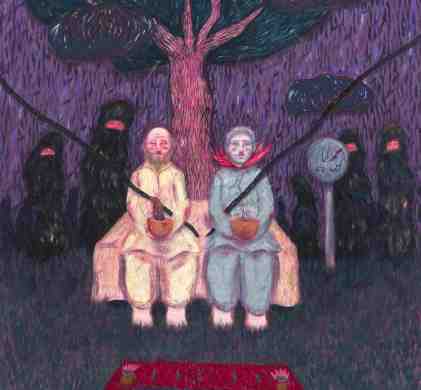
The Cure
Alban’s within reach of the fireplace but still playing innocent, sitting on the carpet in lotus pose. He’s been inching towards it and away from me, peeking back up at me as I iron the clothes, then looking back at the book in his lap as his butt muscles earthworm firewards. When the fire’s five feet away he loses all caution and stares, the fire dancing orange on his face, yellow in his blue eyes. He leans over and reaches his arm towards the grate, fingers already through the grate, all else forgotten, his body about to fall forwards.
‘Alban!’ I warn.
He gasps, his hand retracts, and he loses his balance and falls over onto the carpet. He giggles, picks himself up, and walks back to his beanbag near my ironing board. I’ve been ironing all morning and the pile’s still endless, as it was yesterday, as it’ll be tomorrow. I wish I’d let him touch the fire.
I walk my old-fashioned iron over to the fire and refill it with fresh embers. Alban watches me hungrily all the while. ‘I just wanted to know how fire feels,’ he says, running his hand sheepishly through his grizzled hair. As he sits below me his hand steals towards my iron.
I slap his hand away. ‘Forget about it. Tell me about your book.’
‘It’s about meme theory!’ He rubs his hands together. His bright eyes, as big as when he was five, leap across the ceiling as he gathers his thoughts. ‘It’s a compendium of research papers. The idea is that, just like genes survive and reproduce based on their fitness, so do memes.’ His face glows as if the fire still shone on it: an unlined face, the complexion fresh, the features open, even though he’s almost fifty, too. ‘A meme is an idea, you know, a catchy one that generates many variations. Like ballgames, or, or,’ he stutters a little in his excitement, ‘berry ice-creams, or eternal youth. Cool concept, right, Aima?’ He effervesces joy and searches my eyes for joy, as if watching me unwrap the best birthday present.
Is it cool? I’m trapped here forever and nothing matters. ‘Here’s a meme for you,’ I say. ‘For centuries, some people have believed that the only way we can really learn is through pain. What d’you think of that?’
Alban laughs. ‘You said that yesterday, Aima, and the day before! You must be getting dementia.’ His dancing eyes invite me to laugh with him. I don’t. His laughter dies. He springs to his feet, his book falling away, and takes my face in his hands. ‘Maybe you do have dementia! We’ve got to find a doctor! Where will we find a doctor on Mars?’
I shake him off. ‘Rubbish. I only keep saying it because you never reply.’
‘Oh, then you’re fine!’ His tanned face relaxes. ‘Well, I don’t think it’s true that you can only learn through pain. If it were true, I’d know it, wouldn’t I? I know a lot.’
‘Yes, you do.’
Something darkens the window and draws our eyes. The eagle, dark against the sun, flits past the window again then disappears, probably to perch on the roof. We gaze down the hill: scrub and grassland for miles on every side, the leaden sky wide.
‘You do know a lot of stuff,’ I repeat, studying Alban’s face, ‘but it doesn’t do you any good, does it?’ I make no effort to animate my flat voice. ‘You’re stuck out here forever, like a loon locked away.’ I know I shouldn’t. It’s like kicking a puppy. But I’m stuck here because of him and he doesn’t even know it. Well, it’s all eleven of them, but he’s the worst. Unquenchable.
Alban’s face spasms with pain and joy surges in my heart. His face scrunches up small and teary-eyed like a toddler’s and my joy sinks cold through my gut towards my feet, leaving my centre hollow. Slowly his face clears. He laughs and says, in the same tone, ‘I know a lot of stuff, don’t I?’
My pulse slows and only then do I realise it was racing, that time had slowed down. For his face didn’t clear slowly, it cleared quickly: the time seemed long to me only because I was watching his face, terrified that this time I had managed to do what I’ve been trying to do for fourteen years: to throw away his love and respect. ‘Yes, you do, Alban. I’m proud of you.’
He hugs me so suddenly I almost drop my iron. I shut my eyes and pretend it’s my son hugging me, my son who has finally forgotten all he’s done to hurt me, who has therefore finally forgiven me. But Alban doesn’t smell like my son: he smells of shaving cream. I open my eyes and run my finger over his scar: two inches behind his hairline, parallel to it, three inches long, smooth and colourless, visible through his thinning hair. I drop my arms. He releases me.
‘Put your book away, Alban. Get some exercise.’
‘Can I help you iron? That looks like good exercise.
Afraid to open my mouth again, I shake my head. He wanders around the drawing room we all share. He stops before the front door of our mansion-sized log cabin. I refresh the water in the steamer and watch him gazing out the windows, left of the front door and right of the front door. Then he seems to wake up, with a shudder in the muscles where his neck meets his back. He looks up at the speaker above the grandfather clock. The others are in the yard beyond the kitchen: over the speaker we hear them playing Catch, cleaning the fountain, and feeding the goats and chickens. He heads kitchenwards. Soon among the other voices I hear his: a rich tenor, which might be pleasant if you didn’t have to listen to it all day.
I don’t have to look out, or even listen to their voices, to picture them: squatting ungracefully over flowerbeds, trying to lure ants up twigs, wrestling in the dry grass. Their piping voices leave me cold.
A shiver of guilt creeps up my spine. I shake it off. They’re not my children. We were born in the same year. It’s sheer chance that’s put them there and me here.
‘But what’s the problem,’ says Dylan, ‘with marigolds and sunflowers in the same plot?’
‘Two flowers of the same colour,’ says Harriet, ‘that’ll look weird, like, accidental. We can do sunflowers and lavender? That’ll be a nice contrast in colour and shape.’
My attention wanders to another conversation. ‘Just wait till spring,’ Tess is whispering. ‘We’ll sneak out the front door and down the hill and search for signs of life beyond the glass dome.’
‘Aima says she’s positive there’s no other life on Mars,’ Jason whispers back, ‘no oxygen or nothing. What if we die out there?’
‘She’s got to be wrong,’ says Tess. ‘How can we have all these birds and trees here, and nothing out there? And it’s just like the photos of the earth in the books. Look, we won’t tell Aima we’re going to explore, that’ll just worry her, but when we come back with good news, she’ll be as happy as…’
I speak into the transmitter hidden in the wood-bead bracelet on my wrist. ‘You’re all jackasses, and you’re on Mars because your families sent you away, and nobody wants you.’
I hear my voice ringing out from the speaker in the garden. Amplified, the flatness becomes harshness. A hush falls on the eleven survivors. I’ve done my duty but I can’t bear to turn and face them through the back windows. I can picture them, suddenly still in the weak winter sunshine. I iron their clothes assiduously. The silence is brief.
‘But what’s the problem,’ says Dylan, ‘with mixing marigolds and sunflowers in the same plot?’
Harriet scoffs. I hear a splash: it must be Tess and Jason, who’ve forgotten what they were doing, and have decided they’re going to splash around in the fountain barefoot in January. I speak into my microphone sweetly to tell them to get out, reminding Tess she’s just got over her flu.
‘Alright, Aima!’ Tess and Jason chorus liltingly, like children. Soon I hear them setting out with armfuls of hay towards the stables, discussing whether the fog is thinner than yesterday. I’m relieved they’ve forgotten the hurtful words they made me say. I wish I could forget.
Why do they get to be happy? I’ve tried all the therapy there is. I grew up envying my sister, wondering whether happiness just depended on the brain you had. Now I know. Oh, I can act happy when I need to. How d’you think I got this job? I always pushed myself. I didn’t want to end up like those losers who break down in their 20s, like a toy train that stops short and says No, they simply can’t, just can’t manage one more lap around the toy tree through the toy station. Not me. I refused to give up, I’ve been fighting all my life. So when the project that wouldn’t let me in on the other side, the project I’d been working for since I was sixteen, wanted someone ‘well-adjusted’ to look after these freaks, there I was.
The grandfather clock strikes noon. I walk towards the mirror, smoothing my hair and straightening my collar. I brace myself. Living around these eleven, my own face is always a shock. Today I see that the wrinkles from the corner of my mouth have cut their trenches almost to my chin. My eyes are leaden, their whites neveragainwhite. My skin, which lied so beautifully when I was young, has done a reverse Dorian Gray and betrays decades of guilt-bingeing on junk. I restrain the urge to punch the mirror. Glancing all around the empty room I remove the mirror and retrieve my mobile phone from the hidden compartment.
‘All well,’ I email. ‘Tess’s stomach flu is almost gone. I said I got the antibiotics from an old pharmaceutical pod I dug up during the night. When they heard that they spent all week digging in the garden. They keep planning a search party to explore the rest of Mars and I keep nipping it in the bud. So they keep hatching the same beginning-of-plan every day, and I’ve got to quell the same beginning-of-plan every day. But it’s manageable.’ It’s like babysitting the world’s easiest, most frustrating toddlers. ‘I bet you they die of old age without realising we’re still in Kansas, just like in their favourite book.’ For nobody’s told these eleven, not as far as they remember, that grownups don’t read fairytales.
It’s been fourteen years. Is anyone still reading my reports? I send the email, lock my phone up again, and return to my ironing.
These eleven are the remnants of a failed experiment. Thirty-two years ago, one hundred volunteers signed on at age eighteen. It turns out that no, people would not be better off if they could forget pain instantly. These eleven can still feel pain, physical and psychological. What they can’t do is learn from pain or remember pain. The surgery lesioned the neural circuits that connect the experience of pain to the process of learning: a pretty simple process, really. These eleven can’t form conscious memories of being hurt. They can’t even experience the long-term potentiation that underlies reflex conditioning a la Pavlov’s dog.
After the 89th death among the 100 – a gang of teenagers kidnapped the subject and tortured her till she committed suicide – the scientists finally tried to reverse the procedure. That wasn’t so simple. The scientists had tried at first to achieve the painblocking effect by altering gene expression. But the gene regulators quickly learned from experience and reversed the scientists’ fiddling. So the scientists had had to perform brain surgery. The subjects’ lesions were permanent. Finally, long after the condemnatory articles and cruel memes had petered down, they gave up on their much-lauded, much-hated experiment. The bigwigs sponsoring the study decided, since these eleven could never function normally, to reward their contributions to science with paradise: a house-in-the-middle-of-nowhere with a full-time caretaker.
So, fourteen years ago, I threw my life away – for good money, paid not to me, for what would I do with money here, but to my children back in Chicago, who told me to drop dead, who probably think their wish came true, who don’t think to wonder where the money’s coming from, because they were always smart that way. The eleven’s families are getting paid too, handsomely: they’re getting the compensation the eleven were getting when we were back in the real world. All the families had to do was agree never to contact them. They agreed. Have you ever been around a toxic-positive person?
The voices in the garden have dispersed. Last to stay out as always are Clint and Patty. He’s whistling and she’s humming the same tune, the whistling two octaves higher and moderately out of tune. The dissonance pleases my ears.
The kitchen door closes softly. I pretend not to hear Alban till he’s crept up almost behind me. I whirl suddenly and catch him, his arms extended, his hands put out as if to choke me. He grins ghoulishly and waves his still taut hands.
Is he just playing, like the overgrown baby he is, or does he remember somewhere in his ravaged brain that I’m the person who hurts him? There’s no guilt in his face but his body is slightly crouching and his fingers curl tense. The scientists assure me that the eleven form no memories after any kind of pain. You don’t think I’d be here, alone among them, insulting them whenever they’re planning something dangerous, for their own silly sakes, if I didn’t believe the scientists? I hate the scientists – I wanted to be among the 100, nobody deserved it better than I did, I who’d hurt so badly all my life, I who’d quit school to wipe their petri dishes and eavesdrop on their lunches – but I believe them.
‘You’re still ironing!’ Alban exclaims.
‘Hmm.’ I don’t have to iron so much every day – these fools don’t know shabby from dead – but there’s nothing really to do. I can’t read and garden all day, here in the middle of nowhere, and care what flower I’ll plant, and pretend what’s in my head matters when nobody will ever know. Ironing keeps me from bashing my head in.
Alban’s watching the steam curling up white from Jason’s button-up shirt, the wrinkles disappearing, the heavy iron sleekly gliding. His face shines with joy and curiosity eternally new. I can almost see his ears perking like a puppy’s as the steam whistles. He’s fifty and dumb as soup but he looks as if the world were still ahead of him, as if nobody’s ever told him he was a burden on society, as if he had a right to be here, well-fed and well-clothed.
Don’t you go pitying him! All the subjects were affluent and well-educated. The scientists spent weeks explaining the proposed experiment to them: everything they knew, and hypothesised, and feared. All 100 gave their informed consent.
Alban is inching towards the ironing board, his eyes fixed on the iron with its base glowing red, his feet close together, his hands clasped, a conciliatory smile hovering around his lips. For he does remember all the times I’ve warned him away from the fireplace, the front door, the iron.
I readjust my bracelet, switching off my speaker. After all these years, is anyone still listening? But you can never be too careful. I know I whine a lot, but I need this job.
I look up and catch him sneaking. He stops short with a foolish grin. ‘You’re curious about this, aren’t you, Alban?’ I smile, as if he were my son, my eldest son when I hoped against hope that my children would fix me, before I broke them too. I glance all around. Outside the front windows the prairie stretches endless. The speaker from the garden buzzes softly with the wind: the other ten have gone to dress for lunch.
‘I know it’s fire,’ Alban replies. ‘I just want to know how it feels.’ His voice whines and my heart hurts. I never could tell my children no.
‘Come, Alban. Just this once, I’ll show you.’
He perks up, eyes shining, face happy, simply happy like a lab dog when you pick up the stick after you told him you’d never play Fetch again.
‘Roll up your sleeve, darling.’
He rolls up his sleeve and looks curiously at the scars, shaped like curved Vs, running from his wrist towards his elbow. The ones near the wrist are fainter and smoother, but all of them have healed and scarred over. I’m not a monster: I just do this once a month. He cocks his head with interest, and rubs at the scars with his forefinger. His face remains blank and his eyes wide. He looks up at me. I’m holding the iron up. His smile is like your long-lost dog wagging his tail when you weep with joy to see him and say, ‘Come!’
He walks around my ironing board, his arm bare, his child’s face squirming with joy that he will finally discover how fire feels.
Don’t go judging me. He won’t remember a thing. I’m the fool: I wish I were him.