
Note 4
In 2008, protests erupted over the inclusion of AK Ramanujan’s seminal essay, ‘Three hundred Ramayanas’ in the Delhi University history syllabus. Ramanujan’s essay made the case that the Ramayana is more than a single text – that it is a multi-linguistic storytelling tradition which proliferates in oral, visual and textual forms.
The protestors were in part, uncomfortable with the idea that multiple versions of epics and myths exist, and that these versions often differ. But, when a single ‘correct’ version dominates we lose a great deal. For, as Ramanujan wrote, ‘Every author, if one may hazard a metaphor, dips into it (the Ramayana) and brings out a unique crystallization, a new text with a unique texture and a fresh context.’ This process, by which writers adapt the myths that inspire them to reflect the concerns of their particular time, renews the power of myth. Thus, myths remain alive, always relevant.
So, it is fitting that our fourth, mythology-inspired issue of Out of Print contains an excerpt from Musharraf Ali Farooqi’s introduction to his translation of the ‘Tilism-e Hoshurba‘ describing how stories grow and change as they travel across continents and cultures, and through different times. In Devdutt Pattanaik’s ‘Iravan‘, the age of the Kurukshetra becomes a distant mirror of our times, reflecting the complexities, ambiguities and the blurred boundaries that characterise a post-modern generation.
In ‘The Winning Move‘, Neeta Deshpande evokes the myth of the Goddess Renuka Devi (also known as Yellama), where the bodies and heads of an upper-caste woman and lower-caste woman are switched, and recalls a similar tale from Kathasaritsagara which inspired both Thomas Mann’s The Transposed Heads and Girish Karnad’s play ‘Hayavadhana’.
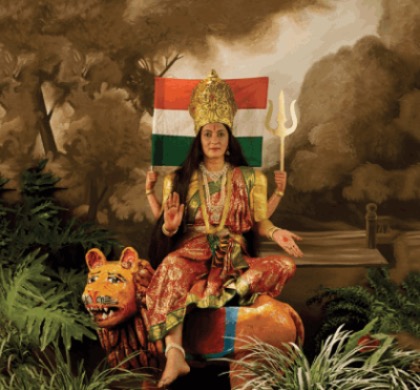
In Annam Manthiram’s moving tale, ‘The Reincarnation of Chamunda’, the figure of the Goddess Chamunda Devi becomes a powerful, contemporary metaphor. Kuzhali Manickavel’s ‘The Dolphin King‘ explores the tragic, futile destiny of Karna and the difficulty of heroism in our times. ‘Sita‘, Samhita Arni’s take on the Ramayana, re-situates the epic in an age of war and terrorism. ‘Motherland‘, a photo-essay documenting the performance piece by Pushpamala N and Mamta Sagar, uses the figure of Bharat Mata to discuss feminism and the role of women in the context of nationalism.
The art on the cover of Out of Print 4 is by Pushpamala N.
We chose, in this issue of Out of Print, our fourth, to feature contemporary art because we see the visual as having been a critical, and often vernacular, medium to circulate, change, perform and interpret mythology. We are fortunate that celebrated artists Pushpamala N, Jitish Kallat, Ram Rahman, Ratna Gupta and Naz Ikramullah have generously permitted us to use images of their work.
This time, when you click on the story title on the cover page it will lead you to the image that accompanies the text. By clicking on that image, the story will appear.
The art on the cover of Out of Print 4 is by Pushpamala N and is titled ‘Motherland – The Festive Tableau’, in studio portrait from the series Motherland, photo credit, Clay Kelton, 2005.
The images that accompany the stories in the issue are listed below:
- ‘The Dolphin King‘ : ‘Universal Recipient’ by Jitish Kallat, acrylic and metal paint on canvas, bronze, 241 x 173 cm, 2008-2009.
- ‘Reincarnation of Chaminda’ : ‘Metamorphoses Retold’ by Ratna Gupta, one of 18 body casts in resin, 2007.
- ‘Introduction to Hoshruba‘ : ‘States of Mind’ by Naz Ikramullah, collage and mixed media on paper, 66 x 91 cm, 1990.
- ‘Iravan‘ : ‘Motherland – The Great Sacrifice’ by Pushpamala N, in studio portrait from the series Motherland, photo credit, Clay Kelton, 2005.
- ‘Sita‘ : ‘Ram Lila, Red Fort’ by Ram Rahman, photographed on site, 1995.
- ‘The Winning Move‘ : ‘Untitled (When will You Be Happy)’ by Jitish Kallat, resin and steel, approximately 200 feet, installed in the ancient burial site of Pilane, Sweden, 2010.