
Note 61
I cannot begin to put my thoughts down these days without images of the imbecility that power breeds, and the destruction and annihilation it engenders, coursing before my mind’s eye. This tends to make me spend less time reflecting and valuing, and more dwelling on the vicarious imagery of madness and cruelty. In other words, rather than focussing on reading and thinking, I am distracted by seeing and reacting. The seven stories in the current release of Out of Print have, however, led me in just the opposite direction, drawing me towards examining situations where characters deal with the consequences of often irrevocable destabilisations in their worlds.
The stories in this edition are
Geetanjali Shree, OUT FOR A SPIN, translated by Daisy Rockwell
Prateek Nigam, EVERYTHING DISTANT FAINTLY PERCEIVED
Anwesha Panigrahi, A VILLAGE OF LIARS
Jay Samanta, BEAUTIFUL RUINED THINGS
Anand Prakash, A TALKING DATE
Satyaki Khastgir, UNDER PROCESS
Praveena Shivram, THE KARUNA COMPLEX
In Geetanjali Shree’s ‘Out for a Spin’, translated from Hindi by Daisy Rockwell, a women walks compulsively through her housing complex. She is bound to her path by unknown forces, and we follow her thoughts as she critiques, observes, scolds, reflects, and worries about her body, her mind, her neighbours, their attitudes to shared spaces, and so much more as she revolves along set paths. Translated deftly by Daisy Rockwell, we are given a flavour of the author’s maverick relationship with verbs and nouns.
Prateek Nigam opens a window into a particular type and level of exploitation in ‘Everything Distant Faintly Perceived’. This is a story that leads us to address how a character’s sanity, and sense of self and place in the world are impacted when a taste of celebrity and stardom are dangled in front them. The story lays bare how deep corruption can run when there is embedded imbalance in society. Also examining societal inequalities, ‘A Village of Liars’ by Anwesha Panigrahi highlights the colour divide (representative, we presume, of the frequently causal class and caste boundaries) in a village – and the violent consequences of breaching that divide. How does a young man negotiate a terrifying reality that he has been party to? A story that slips and slides alongside the reality of a village full of people that the young narrator perceives as routinely obscuring the truth.
Jay Samanta’s ‘Beautiful Ruined Things’ is told through the lens of the protagonist. She must assess the structural integrity of a building owned by a man whom she is drawn to despite herself, someone she first sees ‘smiling like a man who had already won’. She faces herself and her weakness that, notwithstanding the honesty of her regard, does not permit her to control the narrative. Attraction is also at the core of Anand Prakash’s ‘A Talking Date’. A young Indian in America is ill-equipped to understand the basics of a relationship with a woman, having no real sense of her emotional needs, nor his. When, inevitably, they break up, he is sad, and lonely. The story explores the difficult terrain the protagonist negotiates as he must follow a path that will lead, we hope, to knowing himself.
Satyaki Khastgir transports us into an entirely different world with ‘Under Process’. A classic bureaucracy story where power is wrested from the individual and held by a mindless administrative being, in this story there is an additional twist that adds a layer of menace and disquiet. The relationship between characters: ‘Sharmila … noticed how thin his wrist had become. She reached out and adjusted the edge of the bedsheet…. Her fingers rested there for a moment longer than necessary.’ emphasises the loss inherent in the wresting of power.
‘The Karuna Complex’ by Parveena Shivram exposes layers of injustice, corruption and abuse that seep into the interstices of the life of a family disadvantaged by poverty. A sister, caught in a harsh trap of domesticity, thinks about the cruel and unjust fate of her young brother. Playing with the insertion of verse within the prose, she tells a story that is all too familiar if we allow ourselves to see it.
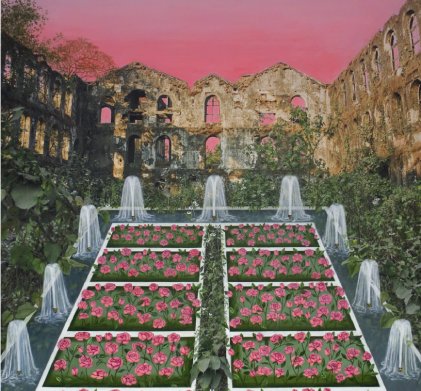
The cover art in the issue ‘Rose Garden’, acrylic and digital print on canvas, 45 x 42.5, 2014, is by Meera Devidayal from the exhibition A Terrible Beauty in which she looked at ‘the life and after life of the mills in Mumbai, drawing references from art and architecture’.