
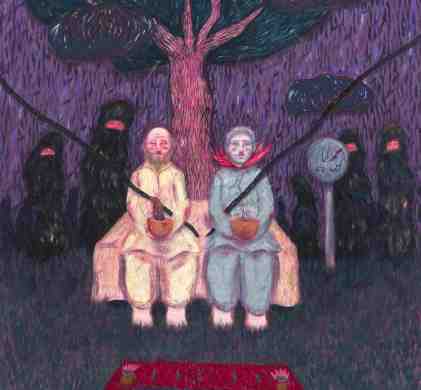
The Rain
The rain came as a relief. It came suddenly, unexpectedly, without any warning. It beat upon the roof, and the echoes filtered down to the room beneath and floated there vaguely, like invisible grey feathers. The silence that had palled the room was shattered.
It was a relief. Now there was no need to try to make conversation. At the most one would say brightly, ‘Oh! What a downpour!’ and smile wonderingly, and the other would reply, ‘Yes, isn’t it?’ and reflect the smile. The fierce downward thrust of the rain drowned their voices to a whisper, so that they had to shout to make themselves heard. Then one would pretend to be amused and exasperated by the whole thing, and smile listlessly.
This had been going on for more than a year. Two monsoons back! They had just then married, and had thanked the rains heartily for closeting them together for hours at a stretch. It was cold and dreary outside, but warm, cosy and intimate inside. They had so much to say to each other: about themselves, about their parents, relatives and friends; about their work, their hopes, fears and ambitions, about so many things, so many jokes, stories, anecdotes. And so much to do: smile, kiss and embrace…. And the rain had been obscured by their gaiety.
*
Now there was no conversation. Their small talk was exhausted. The room was a vacuum in which no scrap of conversation floated. The silence was broken only when one of them switched the radio on. Consciously or unconsciously trying to hide the silence, the cold, the gulf. Now it was cold and dreary inside, while the beauty of the elements roared outside, reeling in silver threads. She longed to be outside. But that, of course, was impossible. She was a wife and his wife.
The rain was a relief. There was now no need to talk. One uttered commonplace remarks. One could not say aloud even one’s thoughts about the rain: how it came, how it behaved, how it departed. It sounded mad, and not at all the thing to say. It was merely embarrassing. All one said was, ‘Oh! What a downpour,’ and waited for the echo.
The rain came and went, lingered and vanished. It came coquettishly like a bright-eyed girl: dressed in warm-toned velvet, red, purple, voluptuous; wickedly perfumed; full-lipped and firm fleshed; sure of herself and of her power over others; fanning herself, enticing and laughing at her victim. It came like a teenage girl smitten by first love: dressed in light, flowing white; sweet and young-scented, unsure and hopeful; fearful, anxious, desiring to please, adoring. It came like a devoted wife: with no pretensions or fine trappings about her, but firm and fine, staunch and sustenance giving.
The first did no one any good. With its fluctuations and uncertainty, it only caused wet clothes, colds and unpleasantness. The second was refreshing, light and frolicsome; but, lacking strength and firmness, was not of much use. It did succeed, however, in evoking nostalgia and sentiment! The third was the one which though appearing dreary, and dismally, boringly constant, nourished the soil and caused the green to flower.
*
It came like an adolescent boy, worshipping, shy, awkward, diffident. It came like a husband, sincere, soothing, sober. It came like a lover, powerful, thrilling, dynamic, gasp-evoking. It came like slightly sweet young love; like throbbing adult love; like moss-green love, love lichened with complacency. It came like passion. It came with scarcely a warning, it seized hold of you, it bound you, it shut out everything else, it painted the world with magic. It submerged you, it drowned you, it receded; and then, just as you were about to recover and stretch your limbs lazily and relax, it rolled in again, and swept you in its death-tight embrace. Then when you swooned in ecstasy, it strolled back, triumphant, smiling, kind. And then, relaxed, refreshed, calm, you sank back and slept.
If one told him all these things! He would make a few bawdy jokes and enjoy watching her wince. She had never been able to enjoy his risque jokes.
Knit, purl; knit, purl. She had lately learnt to knit. It helped pass the time. It would make her look as if she was busy, it would be an excuse for being silent. It would screen her uneasiness and desolation. When she was a young girl, her friends used to learn knitting enthusiastically. She never would. She tossed her head and ran out to play, saying that knitting was fit only for old women. ‘I will learn it when I am a grandmother,’ she had said, laughing. And here she was knitting away, though she was not even a mother…. Not even a mother. She was knitting a scarf for him. She had knitted him many things. He rarely wore them. Only when it was very cold or when he was ill. Then he came to be petted and comforted. Then she was a mother.
She either knitted or read. She often read till the pages became dog-eared and her brain tight-sewn with words. So that it could only feel emptiness. She read even while she cooked. He had come in one day and seen her reading in the kitchen. He had patted her on the head and said indulgently: ‘Studious little girl.’ Little girl. Little girl.
Rain. Never-ending rain. The day began with rain and ended with rain. The days were wrapped up in rain. But for the clock, ever vigilant, Time would have stood still. Time would have been a cloak of grey. All things were done to the accompaniment of rain. Eating, sleeping, singing, dreaming, talking, worrying – even love-making. It was perhaps a good thing. Perhaps he would mistake the steady rhythm of the rain outside for the non-existent throbs of her cringing body.
*
Yes, the rain was a relief. One could spring up from the sucking arms of boredom and say cheerfully, ‘I’ll see if the windows are closed,’ and glide out. Then one could linger in the dark rooms, near the windows, making no efforts to close them, surrendering one’s face to the wind’s harsh, hurried embrace and to the rain’s rhyming whispers. In semi dark rooms, alone, one could pass the moments happily. ‘Yes, the rain was a relief.’
They had been sitting like this for a couple of hours. The rain, all of a sudden, whimpered to a close. Music flowed once more from the radio and brushed the furniture with gold. He yawned and stood up and said: ‘Shall we go in to dinner?’
She got up smiling, nodded and went in.
‘The Rain’ was first published in The Illustrated Weekly of India on the 21st of November, 1954.
It was reprinted in Sangama – Pastorale: The Kannada and English Short Stories of Rajalakshmi N Rao (Ed.) Chandan Gowda, Sankathana Publishers, Mandya, and Kathana Studio, Bengaluru.
A note from Chandan Gowda, the editor of Sangama – Pastorale:
‘The Rain’, Rajalakshmi N Rao’s debut story in English, like a bulk of her other stories, was written in Kalyan, a suburb in Mumbai, where her family was living at the time. Since her father worked in the Military Engineering Service and was frequently transferred, she completed most of her schooling and college education from home. This left her ample time for books, painting, and music. English literature, history, and philosophy were the subjects of her undergraduate study. She read widely among major English, American, and European writers of her time, including Turgenev, Chekhov, D H Lawrence, Aldous Huxley, John Steinbeck, and William Faulkner, as well as psychoanalytic thinkers such as Freud and Adler. Writers who, to use her term, looked ‘inward’, including Virginia Woolf, Rosamond Lehmann, and Elizabeth Bowen, held particular appeal for her. A dozen of her English stories, recently retrieved from the archives, offer an intense probing of the existential strivings of educated women for freedom. Written in prose suffused with metaphoric inventiveness and philosophical depth, these works place her in the company of major Indian writers in English.
A pioneering woman modernist writer in Kannada, Rajalakshmi N Rao’s anthology of powerful short stories in Kannada, Sangama, (Suruchi Publishers) which received critical notice upon its publication in 1956, disappeared out of view after she left her husband and little daughter to pursue spiritual inquiry and withdrew from writing altogether. Although occasionally anthologised, her Kannada stories, which display a rich range of thematic concerns, have nevertheless met with near-total neglect by the literary community and continue to await sustained literary engagement.
Across moments unfolding over three monsoons, ‘The Rain’ reveals the waning of eros in a married couple. The briefest glimpses of the husband’s insensitivity reveal the wife, the narrator, confined in a dissatisfying predicament. The stakes are nothing short of existential. She mourns the disappearance of passion, ‘which painted the world with magic’ and ‘swept you in its death-tight embrace.’ Beyond affirming the passionate life, the original, modern imagery of the rain radiates further philosophical reflections. These are only a few observations on a story whose delicate narrative folds hold far more.