
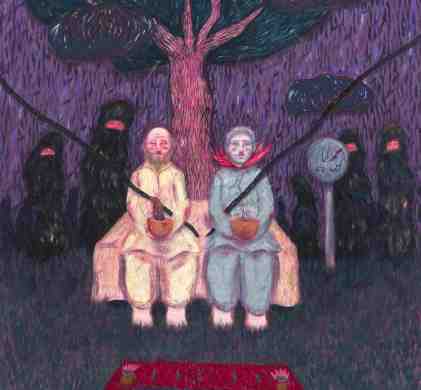
Shiuli
One can lose a mother in many ways. She could die. Or change into another person. She could walk out and lose her way. All I knew was that on Dashami, Ma was gone.
In every other way, the world was strangely normal. The sun, the dust, the birdsong, the Bangalore traffic were exactly as they had been before. Crackling autumn leaves lay about in heaps. The house looked the same. The faint fragrance of bel-phool hung in the air. The calendar swung and scraped a crescent on the wall. Strands of silvery hair fluttered in her comb. The slight hollow on her bed remained.
Both her suitcases were at home, as were her photo albums. But she had disappeared. Her phone yielded nothing. She had not left a note. No money was missing. Nothing turned up in frantic searches across empty puja pandals, bylanes, railway stations, bus stands and police stations. None of our relatives had heard from her. My daughter wept, her eyes accusatory. I kept running around with my head pounding and a lump stuck in my throat. My wife handled the business end, filing the missing person report, the newspaper ads, the posters promising rewards for information, posting on Facebook and WhatsApp groups, calling up hospitals and old-age-homes. The photo we chose to post wasn’t pretty; but it was accurate. She sat in the balcony chair in a ruffled white saree, gazing blankly at the camera with no expression at all. The harsh early sun caught the creases of her deflated skin, her tousled silver hair, the gap in her teeth and a pinched, forsaken look.
My despair seethed, flared up in anger, and then subsided to a dull throb in the solar plexus. How could one be so careless? How could she put us through all this? Or, was it simply an accident? Did we ignore the symptoms of dementia? She repeated things. She had lost her way before. But that happens to the old, doesn’t it? Doubts and rumours gathered like a storm. The police, hapless and clueless, turned to me – did I kill my mother? Did you quarrel? Of course, but … Was it about property? Money? It was ridiculous. Ma owned nothing after Parijat, our house in Selimpur, Calcutta was sold. That money was split between my sister and me. Any suspects? Did she have enemies? How could I explain that she had almost nobody in the end. Noticed anything strange? All the time. She would even forget my wife’s name. What could I say?
I kept combing the neighbourhood in unending loops, showing her photos to everyone and asking if they had seen her. Nothing, but for a few false alarms. She may have worn a mask, and if she had visited a Puja pandal, her face might have been smeared with vermillion. Still nothing. The police would call my sister and then she’d call me. In that stifling pall, every question was an allegation. How can someone vanish? What was the last conversation? She was pining for home. Did she return to Selimpur? Why don’t you search for her there? It was futile. There was no way she could have travelled that far alone. Why can’t you look? Why don’t you want to try? What are you avoiding? What are you doing here? Can’t your wife handle it here? I had no answers, or clues, just questions. What was I doing? I was a fly buzzing against glass, willing it to be air. I needed to escape to breathe. My wife said it might be good to keep moving. That’s what pilgrims do.
*
She called our place ‘my son’s house’. Her heart, it seems, had space just for one home. Ma hated living with us. When she came, my wife and I were working from home and our daughter was having all her classes online. Conversations jostled for room. Am I audible? Sohini, show us your drawing. Next slide please. Cameras on please, everyone. An unprecedented human tragedy. Roll number 15? Internet issues. Covishield or Covaxin? I’m sorry for your loss. Hello! Can you hear me? Demand recovery is 15%. Your video has frozen. Papa, I need your phone. Does turmeric help? Can you see my screen now? We have run out of vegetables. Another call at nine? Sure. You know what? The maid tested positive. Guys, it is sad but we will also need to lay people off. Babushona, are you busy now?
Ma would wander from room to room, wondering what she could do. She had a nervous tic.
What do you need, Ma?
Shona, where is the bathroom?
I had to switch the camera off each time she would float in like a spectre. I would end a call and find her worried, furrowed face staring at me. She would ask me to not spend so much time looking at the computer screen as if I had a choice, to have milk, not coffee, and to sleep early. It was exasperating. My wife and daughter complained about the constant interference.
Once that initial, polite phase wore off, we took to ignoring her. There was no other way. There was a balcony she could look out of, and she would stand there till her knees ached. For her, Bangalore was a baffling steel-and-glass cage with lakes of sewage that overflowed, narrow streets of darting two wheelers, and people who did not speak Bangla. She would open and shut windows, drag a chair to the table and shell peas, then go to her room and pray. Then she would try to wash the used dishes, and leave the wash area a mess.
Are things fine at Parijat? Can you find out?
I won’t. It’s a house, Ma. We sold it. It’s not ours anymore. Why should we care?
It’s crumbling. The floor has cracked. You can’t abandon the house you were born in.
Ma, please….
The smell of the prodeep, stale flowers and the dhoop-kati filled the house. I told her we couldn’t have it. The smoke was irritating and toxic – even if it had Gods printed on the pack. She took to closing her door and sticking the incense-sticks in flower pots. She was stubborn and when confronted, would feign forgetfulness. Oh, I forgot. Not even on the balcony? Allergic asthma was rampant in my wife’s family. We couldn’t take that chance. Ma kept combing the small mousy braid her hair had depleted to, and left clumps of shed hair on the floor. She cooked stuff she assumed we liked. If we accidentally praised anything she cooked, she would start cooking it every day. There was deep frying on high flame, acrid oil-smoke, the drone of the chimney when she remembered to switch it on, and viscous grease in stalactites on the exhaust grill. Our modern kitchen was turning into the sooty coal mine Parijat’s was. When asked to modify her ways, she would get irritable, or promise to change and forget. Once, when I had just got off my evening calls, she walked in perspiring from her cooking and asked me what I would like to have.
Peace, I remember saying … and some space.
What could I do? I grew tired of her being in the way, and especially when she would ask what she should do. Do whatever you want. Please don’t ask me that again. Then she would ask my wife the same question. My daughter may have caught our reactions. She also started complaining. Papa, you know when I take her downstairs, she gathers dirty shiuli flowers from the road for the Gods and you know where she puts them when they dry up? In the flower pots! My wife had other issues. There was a certain way she liked her kitchen, her utensils and her cushions to be. Ma was fidgety and would keep rearranging things. She hung up an ugly calendar from the medicine shop. She started storing polythene bags under her mattress. She thought it was inauspicious to switch the porch light off in the evening, and then it started attracting bugs. She would open cupboards that housed our personal things and we’d think she was spying on us. When confronted, she insisted her albums were missing. Is it possible that Bouma has taken them?
Come on, Ma. Why would we steal your things?
Those were my memories. I can’t find them. Do something Babushona!
I was losing my mind. I’d ask her to stop, to not advise us, to stop using that carcinogenic talcum powder and her smelly hair oil, to reduce the volume on her phone, and to not force the sham of homoeopathy on us. Every time she would ask, then what should I do?
She became increasingly forgetful. She would leave the gas on and the tap running. She would start dressing up at midnight. She repeated things. After she lost her way in the compound, I asked her not to step out alone, and because there was no one to accompany her, she would sit in her room and mope. But every hour, like the Cuckoo in the clock, she would be out trying to converse.
Can you take me to Kalighat?
We’re in Bangalore, not Calcutta. Remember?
Will tuberoses grow here?
I don’t know, Ma.
Can we get some bulbs?
I’ll ask around.
Is there something else I can do?
No! … I mean, I don’t know.
She would blink, apologise and shuffle to her room. But in a minute, she would return. Had I seen her spectacles? Was I busy? I felt guilty though I knew it wasn’t my fault. I knew I should speak to her more often, but it was difficult, and it wouldn’t help. On rare occasions, I’d tell her I was free. What’s it now, Ma?
You know, my nerves give me grief. Is it the sciatica thing Boudi talks about? It feels like hot needles tearing through. And the tooth is wobbling again. What should we do?
Ma. MA! Please. I don’t know what you should do. I can take you to a doctor if you want, but you are fine. You’ve become a hypochondriac. You imagine things. There is a term for these pains – psychosomatic. They aren’t real. And now I’m busy. I’m sorry, but I have to jump on to a call. We’ll talk tomorrow. Ok? And please don’t feed that kitten, Ma. It bleats outside and it’ll start peeing here.
My wife would mouth, ‘Go easy’ from behind her, as if I didn’t want to. I knew I should be patient, but each time, I would snap and then hate myself. Perhaps I did not want to see her fading away like that, to accept what was happening. I wanted to change but I couldn’t. I’d put on my headphones even when I was not on a call, and look at a spreadsheet on the laptop. She would sigh and leave. And before I could bring myself to apologise, she would return.
Will you have another child?
What? Why?
I can care for another grandchild before I die. I could be useful, you know. And a single child can grow up selfish.
My wife would roll her eyes behind her, and I would hold my head.
Ma, do you realise how tough it is with a kid? We have jobs. Now that your granddaughter is ten, we can finally work. Having you here is like managing another child. And for the record, you had two sisters. What happened to their unselfishness? Can they not have you stay with them for a few months?
It felt like a prison to all of us with its walls constantly closing in.
We had no choice, though. Her life after Baba’s death was tough in Calcutta. In the lockdowns, the elderly were dying and hospitals were overflowing. We were lucky we could sell that house off even as property prices crashed. This did mean, however, that she no longer owned the home she had named and loved.
*
The kids called it the sinking house. It must have been at ground level at some point, but by the time we sold it, it was three feet below. The road around it was rebuilt every election season without scraping off previous layers. Buildings kept sprouting up after ‘redevelopment’ of old houses and the debris was then rolled into new layers. Every time, the street would rise by six to eight inches. Baba went to the local authorities, all the way to the High Court, but they said the bitumen scraping and milling machines couldn’t work on streets narrower than twelve feet. Our lane was hardly six across. So our Parijat kept sinking and getting darker, like a cave. Every monsoon, rainwater flooded in, and we had to put everything up on beds and footstools till it was pumped out. As Baba ailed, the house grew decrepit, cold and musty. Banyans and strangler figs started prising the walls apart, their roots like pythons. Cracks appeared on the red cement floor. Ma insisted that there were Muslims buried underground and that their spirits were pushing the floor up. Well, technically the colony was jobor-dokhol, encroached in the post-partition mess. Some parts were actually built over graveyards, but those were stories that we kids did not like, about pitched battles, the eviction bill and the UCRC. For us, the bitumen story was enough. It was Ma’s shoshur-bari, her father-in-law’s house. She claimed that her early years there were tough. Thakuma, my grandmother, whom I remember as a chubby lady brimming with stories and treats, supposedly had an evil side reserved for Ma, who was relegated to the kitchen, kept busy and given leftovers to eat. I don’t know how true this was because Ma did have a thing for melodrama.
After Baba’s parents were no more, she planted a spindly shiuli in the narrow bed along our boundary wall, its bark slimy and mossy. Due to waterlogging and the lack of sun, it almost never flowered. But as it grew, the sinking house built on the bloodied land grew on Ma and became hers. When the new nameplate was installed after my grandparents’ death, she named it Parijat.
She had a story about a famous shiuli tree in her village house. Her father had planted it when she was born, and it flowered throughout the year. That was impossible, though. I would read aloud from articles on the internet. Ma, listen to this. Shiuli, or Parijat, the night jasmine, is a strange tree that flowers only in October, around the Durga Puja. The orange-stemmed white flowers bloom in the dark of the night and fall off before sunrise. It is said that Lord Krishna brought this divine, wish-granting tree to the earth for his wife Satyabhama. Others believe that Arjun brought the tree from heaven for his mother Kunti, who offered its flowers to Lord Shiva. Another fable says it’s the tree of sorrow. It grew from the ashes of Princess Parijat who was scorched by the Sun God. The flowers are her tears. By this time I would chuckle. She would get angry and walk away.
Between the deaths of her in-laws and Baba, Ma ran the house. We weren’t around. I started working in Bangalore. My sister got married and left for the UK. She could visit once every two winters, splitting that week between us and her in-laws. I got married, and then I had my own family – who hated Calcutta. To them it was a muggy, decomposing city that smelt of fish, sold mysticism, and was thronging with nosy old people like Ma.
All she had then was Baba. Our globe-trotting, candy-gifting, always-busy, almost-stranger Baba suddenly had stage-4 cancer, and within months, her life was reduced to taking care of him. She did everything – from waking up early and managing his medication, his food and his faltering walks to cleaning his bedpan, urine flask and spittoon. My sister and I took turns visiting, but honestly we did not help much. It was hard. When he passed away, my sister and I thought it unwise for Ma to live alone in a house full of painful memories. Covid was in the air. Her health was precarious. She was in shock and did not have an opinion, or a passport. Didi lived in London. So in the end, the pleasure was all mine. A local builder bought the house and gave her two months to vacate, and just before the first lockdown, I brought her to Bangalore. She carried two photo albums and two suitcases. We sold off the furniture and most of their belongings. She said did not need anything, not even her memories. It was much later that she opened the albums.
*
In her last week with us, Ma had gone silent. She had stopped asking what she should do. She did not complain of pain. Occasionally, she watched us intently and at other times she looked right through us, confused and glassy-eyed. She went through the photo albums all day. It felt strange but I was sure it was a passing phase. Our daughter declared, Thakuma is weird. She acts crazy to get attention. Ma didn’t ask us to take her to Puja pandals. I assumed those were Covid fears. She sat in her room, listening to Geeta Dutt songs on her phone and humming along. She kept her lights on through the night. Once I overheard her conversing with Baba. I did not have the heart to interrupt her. I remember the song that was playing. Meri jaan, mujhe jaan na kaho. She was giggling.
I later rewound and played every memory, every frame from that week. There was so much that presaged what could ensue. Or that something would. But I missed all clues. Or I noticed and ignored them – it was a sickening feeling.
I did nothing.
We had one conversation that week. It was around nine in the morning on Navami, I remember. I noticed her entering with flowers in the anchal of her saree. Did you go out alone? Ma, please! She smiled and walked over, disarmingly normal in that moment. She looked into my eyes like old times, lucid and intent, and ran her fingers through my hair. I would normally pull away when she did that, but for once I resisted my adolescent repulsion. I closed my eyes and rested my face on her shoulder. I asked her why she went to pick flowers. With her blood pressure and forgetfulness, she needed to be careful. The tree will stop flowering soon. What will happen to the flowers if I don’t pick them up? I smiled. Nothing will happen, Ma. What happened to them before you came here? The earth spins, tides ebb and flow, the seasons change. We think too much of ourselves. We don’t matter as much as we imagine. She sighed and said I sounded like Baba. For those alluring moments, she was so coherent that I had to pinch myself. A sprinkle of twisted white petals and orange stalks fell lightly to the floor and a heady fragrance engulfed us.
You keep saying ‘do what you want’. But I don’t know what that is, or what it means. I can’t remember when I last did what I wanted. You should tell me. There must be something that I can do. I hate being a burden. Sometimes, we are unwanted before we’re useless.
I know what is happening. This happens to the old. It happened to my mother.
I did not know what she meant, and I did not ask. Whenever she stroked my hair, I always felt a gush of warm, enveloping peace. A feeling that everything would be fine. I never told her that, though. I feared that as soon as she discovered anything I liked, she would overdo and spoil it. She was like that. She went on.
There was always so much to do. As a child, I would milk the cow, cook, clean the house and pluck flowers for puja. Then school and college. After marriage, I got busy bringing you and your sister up, running the house, and then caring for your Baba; till the day, when suddenly, there wasn’t anything to do any more. My mind is now a vast, empty space. Just darkness and echoes.
But don’t worry. I’m trying. I’ll be fine. Your Baba is also fine.
I asked what she meant. Baba died. Didn’t she remember? The spell broke. She stared in the distance and her eyes dimmed as if the curtains had been drawn. Then she looked confused and walked away, wraithlike, as if I wasn’t there.
It rankled. At the same time, it worried me and I thought of checking on her after finishing my calls. When I was done, she was in the kitchen, cooking. Her shoulders were shaking under her shawl. She could have been crying, or laughing; but as I stepped in, she slid a fish-slice into the oil. A pungent cloud of mustard fumes and steam hissed out and I stepped back, coughing. I hated mustard, and fish. No wonder that chemical warfare thing was called mustard gas. I worried about the chimney sludge. I wished Ma could go away somewhere for a few days at least. We all needed to breathe.
I had calls till late that day. I did go to speak with her that night but she looked right past me. She did not respond. I decided to let it slide, also because I wasn’t sure what I could talk about. She looked tired.
That’s the last time I saw her.
*
Before the flight took off, I fixed my mask and shield, and checked the WhatsApp groups. Nothing. My daughter had been sending me snapshots from the albums. I swiped through Ma’s pictures – in her mother’s lap, with college friends, with me in her lap, at my marriage. I saw a child’s unlined face firming up in youth, hardening, then cracking like plaster with age. I lingered on her last picture and noticed – or imagined – things I should have seen before. Her uncertain eyes flickered with fear and loneliness. I saw an encroaching darkness, a gnawing augury of defeat and the struggle to wrest meaning from life. It hurts to recognise things after they slip away. I plugged in my earphones, clicked on a Geeta Dutt song she loved, and turned the display off. Waqt Ne Kiya Kya Haseen Sitam descended slowly in its haunting, unbearable heaviness as the plane took off. The beautiful tyranny of time. It was an odd relief. For the next two hours, there was indeed nothing I could do.
Jaayenge kahan soojhta nahin, chal pade magar raasta nahin. Kya talaash hai, kuch pata nahin, bun rahe hai dil, khwaab dam-ba-dam.
(We don’t know where we’ll go / We’ve set off but there isn’t a way / We don’t know what we search for / Yet the hearts keep weaving dreams).
Humans seek closure. Not explanation, but meaning.
It was frustrating to not know if what I sought lay ahead or behind. Was she run over? Did the visarjan noises disorient her? A sudden cardiac arrest? Could she be with a relative? Would she suddenly remember her way and simply return home? Or did we lose her long before she went missing? In my veins, I felt she walked away from what was left. I know what is happening. Perhaps for once, she did what she wanted to do and embraced the darkness and echoes.
I exited the airport, took a yellow taxi and let the city flow by in the familiar smells of its morning. We crossed the Puja’s aftermath, skeletons of pandals and torn material flailing from scaffolding. Wood smoke from shanties hung in low curtains. The Dhapa smouldered in unending fires. My eyes watered from more than the smoke as we crossed the Ma flyover. I missed my aloofness. At Birla Mandir I unconsciously bowed my head. It was Ma’s gesture. I gave alms to a beggar woman who promised me salvation. I was desperate. I too was begging. Something needed to work. Ma had religion, homoeopathy, even her faith in life after death. I had nothing.
I gathered my things. Across Dhakuria was Selimpur. Everything in the colony looked the same – the swollen road, the flaking paint and lush moss on the walls. Apart from a few new houses, it was a time warp. The taxi turned into our lane.
The house was missing.
Instead, there loomed a cavernous pit, an empty grave of rubble where our Parijat, my mother’s house, and my youth, used to be. Broken bits of the old walls clung to the sides of the excavation. I asked the taxi driver to wait.
‘Apnar bari?’ He asked if it was my house.
The tyranny of time.
Steep, narrow steps had been cut into the sides of the pit for the labourers. I stepped down cautiously into the hollow our sinking house had left behind. At the bottom, the air was heavy with memories. I walked around dazed, submerged in things I had run from. You can’t abandon the house you were born in. I felt the mud walls and clods came off, sprinkled with the cement, brick and plaster of our Parijat. I remembered our drawing room, with its cloth-covered sofas, the sunmica table, the dining room with its mahogany cupboard and the loudly-humming fridge, the bathrooms with algae on the floor and spiders on the ceiling. But for some reason, I could no longer imagine Baba on his bed, or even Ma. I panicked.
I couldn’t force Ma’s face into focus.
She was gone.
I couldn’t even touch the house before it vanished. All my palms held was dust and ashes.
The taxi honked. It was holding up traffic in the narrow street. I climbed out wearily. Each foot weighed a ton and cement dust coated my shirt. The driver laughed. He said my face was white as lime. ‘Bhoot dekhechen?’ He asked if I had seen a ghost. Or possibly, if I had seen the past. The Bangla word for both is the same. I brushed myself off, pulled the taxi door open and turned around for a last look at what used to be home.
Something caught my eye.
They had chopped off the shiuli. Viciously. The stump clung to the very edge. Withered rootlets hung above the void, clutching at nothing. Shavings of dead bark curled where it had been severed. I stepped over a pile of detritus to touch it one last time. The traffic was getting impatient around the taxi. The driver yelled for me to hurry up.
And there, right below the brutal cut that left almost nothing of the trunk, swelled a green bud. I used my thumb to carefully brush the dust off. A cone of unborn leaves was bursting forth – glistening, implausible, vulgar and oblivious to the fate of everything being death. I held the stump in my hands, coarse and finally dry. I pulled it and it moved a bit. It was strange, after so long, to feel something give. I tugged again. A shower of dirt and pebbles crashed into the hollow, echoing like the distant applause of thunder. The driver rushed to help me, or perhaps to save me from falling over. A bunch of gawking kids started applauding. Bystanders stepped closer. A clamour rose. Hey! What are you doing? Careful! Is he mad? It’s dead. Harder! The roots went surprisingly deep. As I heaved, the fibrous web frayed, and with a protest, ripped. I had scraped my elbow on something and my knuckles bled. I kept wrenching, tugging and pushing till it began to come loose, the root ball dense with gravel and clay. I was on my haunches, prying out what was left with splinters of stone, clawing with my nails. But the very last bit of the taproot clung on obstinately. With all my strength, I gave it another jerk.
It snapped.
This is the winning story of the 2025 Bangalore Writers Workshop R K Anand Short Story Prize.