
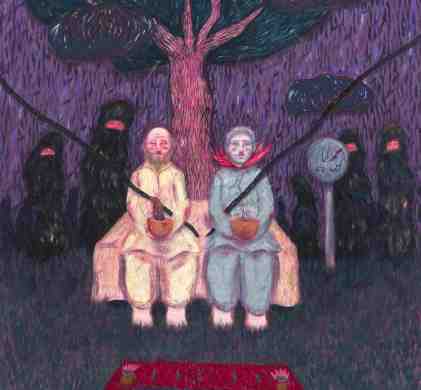
All that We See or Seem
When we woke up that morning, our mother had gone.
I knew it the moment I opened the bedroom door and walked out into the dining room. There was something about the stillness of the house and the absence of the usual re-folded Mathrubhoomi paper on the dining table that made Amma’s absence absolute.
I knew it and I could feel it, but I still went around the two other bedrooms of our rented house, the kitchen, the bathrooms and even the terrace. I shook my brother awake. He must have understood what had happened from the look on my face. He clapped a hand to his mouth and jumped out of bed and went through the same motions as me. The dining room, the two bedrooms, kitchen, the bathroom. He skipped the terrace but made it to the porch. We saw our mother’s 1990 model Maruti 800, parked in its usual place. The keys which used to hang on the brown Kathakali-faced key holder by the living room window were placed neatly on the bonnet. There was no note. The Mathrubhoomi newspaper stuck out from inside the PVC pipe we had tied to the gate for the newspaper boy.
By ten in the morning, our little yard was filled with people. We hadn’t called anyone. We had no one to call. Our father had died after a long and losing battle with cancer just four months earlier.
Since then, it seemed my brother and I had been living in anxiety that our mother would leave us. We had known it like we had always known that the first thing our mother did on waking up was take two Milma packets out of the fridge, snip the corners in such a way that they never snipped off completely, pour the milk out into the milk cooker, and keep it on the stove to boil. It was only after that was done that Amma brushed her teeth and did her early morning necessities. In between the time when the lighter clicked and a fire sparked at the stove, to when the whistle of the milk cooker reached a crescendo that urged everyone, or anyone to switch the burner off but no one did it, Amma finished her morning routines, came out the bathroom and switched it off herself.
When we were younger, the whistle of the milk cooker was our alarm. Papa, Chandu and I would wake up, and trudge into the dining room. Amma would come out of the bathroom, as if on cue, her nightie still wet at the back where her damp, wet hair lay along her spine, and kiss Papa’s forehead completely ignoring us, and make for the kitchen. When she came back into the dining room with coffee for both of them, Boost for me and Horlicks for Chandu, she would give us the most resplendent smile. But her first touch and first smiles were always reserved for Papa. In ignoring us, she made it known to Papa that he was her choice and that we were the inevitables. We behaved like eager puppies, waiting for titbits to fall from the dining table onto our lolling tongues and eager faces. Amma made sure that our titbits seemed like full meals to us. Once Amma finished her coffee, slurping the last bit of froth at the end, we would get up one by one and get ready for school, office and hospital. In the evening, Chandu and I would come home first, followed by Papa. Amma came in last. She brought with her the smell of the hospital where she worked as a nurse and the stories of children admitted into her nursing care. She was transferred four times in our entire schooling period and everywhere we went, we carried over the same furniture, the same kitchen utensils, the same duplicate Godrej almirah and the same white Maruti 800. I don’t remember our parents ever buying anything significant, except the ten-litre Hawkins cooker that Amma insisted was best for cooking biryani, though I don’t remember her making biryani more than a handful of times in our entire lives with her.
Amma never told us that she had plans to leave. But we knew. And at that moment, all I felt was the finality of relief. Chandu smiled through his tears and I knew that he felt it too.
*
Sandheychi had been gone since the morning. I kept looking at her children who sat in the living room, next to each other. The brother had his head on his sister’s shoulder. She was looking into the distance, a small smile on her lips. I was angry at first, to see that smile, but then I reasoned with myself, it would not have been easy to live with Sandhyechi.
I delivered three packets of Milma milk to their home daily, but none of the other customers scared me like Sandhyechi did. She had a way of looking at you that made you spill out the deepest of secrets. Once, just a few months after they had moved here, I had told her that I could bring her goat’s milk from my cousin. It would help her husband. Goat milk was medicine, I told her. But she had given me such a stare that I blurted out that my cousin did sometimes mix cow’s milk with the goat’s milks since his goats were temperamental and did not always yield the same quality of milk, and that my cousin also sometimes mixed water from the tap, especially during summer if milk was scarce and that sometimes he force fed bone meal to his goats and that he got the bone powder not from cattle feed, but from the crematorium which always had a stock of bone ash. I still do not know why I foulmouthed my cousin like that or why I opened my mouth at all.
But once I had spilled all that, and stood shuffling my feet, preparing to bolt if she decided to scream at me, the woman threw her head back in uproarious laughter. I sped away on my moped, praying to God that I wouldn’t skid and fall. Even when I risked a glance back at her once I was safely out of the gate, I could still see her, doubled over in laughter, her faded salwar kameez billowing around her.
*
The boy was the problem. I had known it from the beginning. Such a good family. Unfortunate that the husband was sick of course. Sandhya was the most beautiful woman I had seen, in spite of her yellow-brown cat eyes. The girl hadn’t gotten any of that beauty. They say that daughters take after fathers. So maybe she looked like him. I hadn’t seen early photos of the husband, so I had no way of knowing what he looked like when he was healthy. When they had come to live here, as our neighbour, he had already had multiple surgeries done to his face and half of it was already gone, covered up with what looked like a rubber patch and a tube that was clipped along his face right to his neck where it disappeared under the shirts he wore. The son however, looked exactly like her. The same oval face, thick wavy hair and cat eyes that sparkled when he looked at you. And this was the problem. A boy who looked too beautiful and way too fragile. I had tried asking Sandhya once if they had shown him to a doctor and Sandhya had laughed.
‘What for?’ She had asked me.
I had been taken aback, but I had ploughed on, ‘From one mother to another, Sandhya, let me tell you this, my sister’s husband’s nephew on his father’s side had the same problem. They ignored it for so long that they couldn’t get him cured. But you can, you know?’
‘What is this problem you are trying to tell me about?’
The way she asked it, as if she was challenging me to find fault with her son, made my toes curl and had me forget my prepared little speech, all about how what they call homo something something could be cured if treated by the right person.
I stood there trying to find the right words for her son when Sandhya told me, her eyes boring into me, (I will never forget that look. Never), ‘He has a partner. We have met him. He is a nice boy and keeps our Chandu happy.’
And now, apparently, she’s gone missing. I have half a mind to say ‘good riddance to bad rubbish,’ but since I don’t know who to say it to, I continue staying put in my kitchen, which faces their ridiculous, leafless garden. I chop up beans for the thoran, all the while keeping an eye out for whatever’s happening over there.
*
To be honest, I was relieved she was gone. For the past four years, I’d been trying, unsuccessfully, to raise the rent. Every year, she agreed to the standard 10% increase, but nothing more. With her husband’s illness and that boy not seeming to hold a job, and the girl with her camera and men in ponytails who dropped her off at odd times of the night, I thought she had enough problems on her own and I couldn’t bring myself to push it further.
But still, I did try talking to the boy about the rent a few months before the husband conked off. But he spouted back words I am sure she had taught him by heart, and I was left speechless on her dirty porch. And once that sick fellow died, I couldn’t very well chuck them out either. After all, I was the resident association president (5th year running, mind you). It wouldn’t do me good to oust a widow and her kids from my own house.
But she was a headache. Her old beaten down car and her cloth bags and the way she watered the plants in her garden in her frayed tee shirts and shorts. I am a decent man and I would hate to see my wife wear tiny shorts and parade her legs. Not that the woman had bad legs. To be fair, if my wife had such legs when I had married her, I wouldn’t have strayed even a bit in my travels (not that my wife ever found out of course). But this woman and her legs and her devotion to her husband and her children who seemed to make sure that at least one of them was with their mother on all weekends and holidays. There was something sick about it all. The woman had something that made them all swarm around her. Witch.
*
If Sandhya aunty had been my mother, I would have called every police office in the town to find out where she had gone. But of course, her children didn’t look like they cared. I wanted to scream, throw something at them. Make them do something. But they just sat there on the sofa. Holding hands. Were they smiling at each other? Had they done something to her? Did they know something we did not?
I wouldn’t put it past them.
They were wretches. I was sure that what went on between the siblings wasn’t healthy. Incest is a strong word – I picked it up when I watched ‘Game of Thrones’ and I was so disgusted with Jamie and Cerci – and I haven’t really seen anything happen between the brother and the sister, but I am sure that if I had any proof, I could prove it.
Sandhya aunty did not deserve them. She was the loveliest woman I had known. If only you had seen the way she taught me Chemistry when I was struggling with it in my 12th standard. So much patience and understanding. Every twenty minutes or so, she would go to change uncle’s position on the bed. She was scared of nothing, but uncle getting bedsores, she had admitted once. While chopping onions or crackling mustard in the kitchen, she would make sure that uncle’s room was shut. Strong fumes upset him and since he couldn’t cough or drive the irritation away in any way, he would become agitated. Aunty always took such good care of him.
And those ungrateful children too. The daughter, it was her I hated the most. She filled the house with papers and files and books. Aunty always had to move one pile of books from one chair or the other just to sit down after work.
Once I had been waiting for her to come back and help me with my chemistry. I was struggling so hard with molarity and molality and I really needed Sandhya aunty. The house was a mess. Aunty’s daughter was lying on the sofa, a laptop propped on her chest, typing away furiously.
I wanted to make sure she saw how good daughters behaved and so I started cleaning. Moved piles of books onto one corner, cleared the dining table of empty, dried out cups of tea, wiped down the kitchen counter and was looking around for something else to do when I saw that aunty had come in. She stood watching me scurry about said to me in a gentle voice,
‘Indootti will clear it. She is just busy.’
When I tried to protest, she told me again, in the same voice, ‘Indootti is working on a very important project. It is important to her that nothing is disturbed.’
I knew a rebuke when I heard one and I meekly sat down in my usual chair, my chemistry book opened at page 214, hating Indu, Sandhya aunty’s beloved Indootti who kept typing away, impervious to me or her mother or our conversation.
*
I knew I should have told someone when I saw the children digging the hole at night. I was smoking my single daily cigarette on the balcony after dinner when I saw them. The brother and the sister huddled together and carried something out from their back door. Their father had died a few days ago.
He had been close to death when they had shifted to our colony four years ago. But Sandhya had kept him alive with her nursing skills, we were sure.
I wouldn’t have paid attention to them usually. By then, all of us in the colony had come to terms that the entire family was not like us. They never caused trouble. (My wife would disagree. She just had something against Sandhya.) But that night, the siblings looked like a pair of thieves, the way they went about digging that hole near the septic tank. I couldn’t see much, but it looked like a plastic bag and a bundle of clothes. I tried to get a better look but the coconut tree in my yard prevented me from doing so. But they were out there for some time, digging and whispering and making the ‘ungh’ sound every time the shovel hit the earth. Once my cigarette had gone out I didn’t have much of an excuse to linger long on the terrace. But while I was climbing down the stairs, I distinctly heard them laugh loudly and it sent a cold shiver right down my spine, I tell you.
Two days later, when I walked by their house and saw it empty, I walked around the back trying to find out what they had buried. I walked around to the back of their house, near the kitchen and saw a patch of earth that stood disturbed. I saw a spade leaning next to the wall. I know I thought to myself then that if they needed to dispose of evidence, they shouldn’t have left the spade so close to the burial spot. I bit my tongue when the words ‘burial spot’ came to me. I don’t know why I said that. Suddenly, I lost the nerve to dig and rushed out of their front gate. I am sure no one saw me and I went around with this urge to tell someone what I had seen, someone other than my wife who is terrible at keeping secrets. But then I went on that trip with my family to Delhi-Agra-Rajasthan and I forgot about it.
*
Sandhyechi paid me good money. I cleaned her house on Mondays, Wednesdays and Fridays, grated coconut, chopped vegetables and kept it in the fridge in pearlpet boxes, hung out clothes from the washing machine, folded clothes and separated them into piles and occasionally helped her move her husband from the bed to the bathroom. She almost always did the last part alone, not even letting her children help her. But on some days, I could see she was so exhausted that she needed help. The first time I rushed in to help her was when I saw that she was about to tumble and fall while trying hard to support Chettan. From the next time onwards, I stood around while she came back from the hospital in the evening, washed her hands and rushed to Chettan’s side. She never asked me to help her, and she did not allow me to help her either. But I learnt to guess by the way she walked into the house if she needed my help at all, and on those days she didn’t stop me from helping her.
Sometimes Chettan would have soiled himself, poor thing, and the entire room would reek. The bedsheets would be wet and stinky. But Sandhyechi never put those sheets in the washing machine or asked me to wash them. She did it herself, bent over in their tiny bathroom, washing the sheets in the hot water from the geyser. I did offer to wash them, mind you, but she smiled and waved me away.
The children were heartbroken when their father died. But I wondered why. From what I had understood, their father had been sick for the longest time. Even since the son was about ten and apparently Chettan had stopped speaking properly because his tongue had been removed after an operation. Death was always by their father’s bedside and he had waited only because I am sure Sandhyechi had fixed the lord of death with her cat-eye glare and scared him from taking Chettan away sooner. Anyway the day Chettan died and we all went over to help her with the funeral and so on, the children were huddled in the living room and they kept crying ‘Amma … Amma … Amma’ as if it was Amma who had died and not their Pappa. Sandhyechi sat in their bedroom, in the chair by Chettan’s bed, looking at the empty space. Not a tear in her eyes. It made me shudder to see her like that. Her husband had died and she seemed to have died too.
You may call me uneducated and perhaps a little mad. But I am sure if Sandheychi willed her mind into anything she could make it happen. Except of course save Chettan in the end.
*
‘Should we wait, Chechi?’ Chandu asked me as I locked the door behind us and stepped out. ‘What if Amma comes back? She did not take anything with her. Her clothes, her stethoscope everything is here.’
I laughed. ‘What would she come for Chandu? For us?’ The look on his face was the only confirmation I needed.
We knew Amma enough to know that she would not come back. We knew her enough to know where she had gone and why. We wouldn’t go to her. She knew that about us too.